Someone I know has just been put on bedrest at 29 weeks. She already has two young children, and since I have the time and mental space, I scheduled a visit with her today. I dithered about what kind of food to make her. Her family has lots of allergies and intolerances, but since I've become recently acquainted with [everything]-free recipes myself, that wasn't such a problem.
I decided on my pumpkin soup and a batch of pumpkin chocolate chip cookies. I adapted this recipe to make it gluten, soy and dairy-free. I can't believe how delicious they were. I almost think they were better than the dairy and gluten-y recipe. So as a public service, here are the ingredients I used:
1 c. Earth Balance coconut spread
1 c. brown sugar (I was actually out of brown sugar so I used white with a dribble of molasses)
1 egg
2 tbsp maple syrup
1 tbsp vanilla
1 c. Bob's gluten-free all-purpose flour
1 c. teff flour
1/2 tsp xanthan gum
1 1/4 c. quinoa flakes
1 tsp gluten and corn-free baking powder
1/2 tsp salt
2 tsp cinnamon
1 1/2 c. dairy-free, soy-free chocolate chips.
Follow the original instructions.
Wednesday, April 4, 2012

Monday, April 2, 2012
food
I just finished watching this documentary, Think Global Act Rural. I watched it over several nights, as it's quite dense, thought-provoking material, and I watched it with English subtitles, which made my eyes tire out. But I definitely recommend it.
I think the most surprising thing that came up in the film for me is that growing crops and saving seeds was traditionally a woman's job in many cultures around the world. And more than one speaker in the film linked industrial agriculture's theft of seeds with patriarchy. I love the way this film connects several seemingly disparate issues. It's fascinating, and the speakers are all so well-spoken. I especially enjoyed Vandana Shiva.
Oh - and also Claude Bourguignon, one of the last soil microbiologists in France. He talks about how in the early 80s at university he started in agronomy but couldn't stand what the field was doing so he switched to soil microbiology where he was the only student. Shortly after her graduated, the entire department of soil microbiology shut down, a trend that he said happened around the world, so now there are no more soil microbiology departments. He says now anyone studying agriculture doesn't know that soil is alive.
Here is a trailer for the film.
I most definitely recommend it. More and more I'm starting to think that sustainable farming may be about the most radical thing a person can do.
My husband and I also watched Food Inc. a little while ago. I see its slogan is "You'll never look at dinner the same way again," and I'd have to say that was our experience. And I considered myself a pretty food savvy person. After watching it, the very next time we were at the Farmers' Market, we bought some pastured chicken and ground turkey. I'm seriously considering trying grass-fed beef, even though I haven't eaten beef in about 12 years. I have a friend who had similar gastrointestinal complaints after eating (corn-fed) beef but she said she recently was at a party with lots of grass-fed beef and she couldn't stop eating it and she didn't have any complaints afterward.
In addition to the startling information in the film, I liked that it portrayed all the farmers interviewed in a reasonable light. The only villains are the corporations driving all this crazy change. The chicken segment especially got me thinking about debt as a tool of social control. If you eat, you should watch it.
Edited to add: I just did a little research on Vandana Shiva and wow! She studied philosophy here at Guelph! She's also a nuclear freakin' physicist! And she was recently here to receive an honorary degree. She also did an interview on CBC radio - definitely worth listening to.
I think the most surprising thing that came up in the film for me is that growing crops and saving seeds was traditionally a woman's job in many cultures around the world. And more than one speaker in the film linked industrial agriculture's theft of seeds with patriarchy. I love the way this film connects several seemingly disparate issues. It's fascinating, and the speakers are all so well-spoken. I especially enjoyed Vandana Shiva.
Oh - and also Claude Bourguignon, one of the last soil microbiologists in France. He talks about how in the early 80s at university he started in agronomy but couldn't stand what the field was doing so he switched to soil microbiology where he was the only student. Shortly after her graduated, the entire department of soil microbiology shut down, a trend that he said happened around the world, so now there are no more soil microbiology departments. He says now anyone studying agriculture doesn't know that soil is alive.
Here is a trailer for the film.
I most definitely recommend it. More and more I'm starting to think that sustainable farming may be about the most radical thing a person can do.
My husband and I also watched Food Inc. a little while ago. I see its slogan is "You'll never look at dinner the same way again," and I'd have to say that was our experience. And I considered myself a pretty food savvy person. After watching it, the very next time we were at the Farmers' Market, we bought some pastured chicken and ground turkey. I'm seriously considering trying grass-fed beef, even though I haven't eaten beef in about 12 years. I have a friend who had similar gastrointestinal complaints after eating (corn-fed) beef but she said she recently was at a party with lots of grass-fed beef and she couldn't stop eating it and she didn't have any complaints afterward.
In addition to the startling information in the film, I liked that it portrayed all the farmers interviewed in a reasonable light. The only villains are the corporations driving all this crazy change. The chicken segment especially got me thinking about debt as a tool of social control. If you eat, you should watch it.
Edited to add: I just did a little research on Vandana Shiva and wow! She studied philosophy here at Guelph! She's also a nuclear freakin' physicist! And she was recently here to receive an honorary degree. She also did an interview on CBC radio - definitely worth listening to.
Saturday, March 17, 2012
A Householder's Guide to the Universe
I finished A Householder's Guide to the Universe by Harriet Fasenfest some time ago. But I wanted to give it its due here in this space. It is a charming book, mixing her personal histories and viewpoints with practical tips and recipes. I definitely recommend reading it.
I got it from the library, based on a recommendation from Apron Stringz, one of my new favourite blogs (it's a new favourite for me, not a new blog). Unfortunately, I got it along with The Resilient Gardener, which I am still working my way through (Ack! Apparently I talked the title up a little too much. Someone placed a hold on it so I had to return it before I was even close to done). But within 20 pages of The Resilient Gardener, I thought I need to buy this book and have it as a reference. So the bar was set very hard for the Householder's Guide. And as charming as it was and as lovely a read as it was, I don't think I'll buy it to have on reference. I think when I get into jam making, I'll probably want a refresher on her way of making natural pectin from high-pectin fruits and her table of pectin contents of common fruits. But that's not quite enough to merit buying the whole book, for me. Of course, if I were to see it for $1 at a second-hand shop... well, I will gladly take it on.
Anyways... I really like her point of view. Here are some of her words for you to ponder:
"Being home to make a home was not always seen as a form of internment, the way it is today. It was not always th eplace of second choices or no choices at all. Home, for much of our history (for both men and women), was the center of our cultural, emotional, environmental, and physical well-being. It was the engine of our home economy, the place to practice our skills and trades. Being home meant being in place, living on the land you were to care for, surrounded by the resources you needed. But the farther we have moved from the land, the more the arts and trades required to manage a home have lost their significance. If householding is an attempt to bring the wisdom and the systems of the natural world back into the urban environment, we need to reevaluate what being home means."
And I especially enjoy her self-deprecation that comes out more towards the end of the book. I really identify with this:
"It's just that with so much damn intention crammed into a life, a person needs a little camaraderie. Of course, there is the distinct possibility that I'm as annoying as hell, and that even if everyone was home, I'd still be out in the cold. My friend Myo says she loves my 'self-obsession,' but that's because she's Italian and is used to people talking over each other. I understand I'm looking for a very particular relationship. Me: expat New York Jew, living in the land of hipsterism, growing food and still talking about Woodstock. You: someone who likes listening to me talk. Which is why I'm writing this book, I guess. Wow, a captive audience. But honestly, where do we meet?"
I got it from the library, based on a recommendation from Apron Stringz, one of my new favourite blogs (it's a new favourite for me, not a new blog). Unfortunately, I got it along with The Resilient Gardener, which I am still working my way through (Ack! Apparently I talked the title up a little too much. Someone placed a hold on it so I had to return it before I was even close to done). But within 20 pages of The Resilient Gardener, I thought I need to buy this book and have it as a reference. So the bar was set very hard for the Householder's Guide. And as charming as it was and as lovely a read as it was, I don't think I'll buy it to have on reference. I think when I get into jam making, I'll probably want a refresher on her way of making natural pectin from high-pectin fruits and her table of pectin contents of common fruits. But that's not quite enough to merit buying the whole book, for me. Of course, if I were to see it for $1 at a second-hand shop... well, I will gladly take it on.
Anyways... I really like her point of view. Here are some of her words for you to ponder:
"Being home to make a home was not always seen as a form of internment, the way it is today. It was not always th eplace of second choices or no choices at all. Home, for much of our history (for both men and women), was the center of our cultural, emotional, environmental, and physical well-being. It was the engine of our home economy, the place to practice our skills and trades. Being home meant being in place, living on the land you were to care for, surrounded by the resources you needed. But the farther we have moved from the land, the more the arts and trades required to manage a home have lost their significance. If householding is an attempt to bring the wisdom and the systems of the natural world back into the urban environment, we need to reevaluate what being home means."
And I especially enjoy her self-deprecation that comes out more towards the end of the book. I really identify with this:
"It's just that with so much damn intention crammed into a life, a person needs a little camaraderie. Of course, there is the distinct possibility that I'm as annoying as hell, and that even if everyone was home, I'd still be out in the cold. My friend Myo says she loves my 'self-obsession,' but that's because she's Italian and is used to people talking over each other. I understand I'm looking for a very particular relationship. Me: expat New York Jew, living in the land of hipsterism, growing food and still talking about Woodstock. You: someone who likes listening to me talk. Which is why I'm writing this book, I guess. Wow, a captive audience. But honestly, where do we meet?"
Tuesday, March 13, 2012
sweet dreams
As I write this, a bunch of sap is bubbling on the stove. I did a test drive several days ago, and didn't quite have enough sap to make true syrup, but the 50 mL of golden sugar water we did get was delicious. I figure I'll add it to tonight's batch to bring it closer to a syrup.
Since I got this idea to tap our trees, I keep having dreams that my breastmilk is actually maple syrup. Two or three times now. It's weird.
It hasn't been all smooth sailing with the sap collecting (nor with the breastfeeding either -- but I don't feel like writing about that right now). After we tapped two trees, we got a couple of litres of sap, then a cold snap meant no more sap. On Sunday it started flowing again, but it seemed the holes had dried up or something. So I took out the taps and redrilled the holes. I tried to google how to remove the taps but every page I looked on said simply, "pull the taps." Eventually my husband figured out to use needle-nosed pliers and just pull hard.
I tapped two more trees and just used four-litre jugs that we had gotten apple cider in. This morning they'd blown across the yard, and they wouldn't stay on the trees all day. Of course it didn't actually matter, because for some reason those trees weren't giving me any sap. One of the ones I redrilled has been quite generous though, and is largely responsible for what's boiling on my stove right now. Next year, I will make sure to buy buckets if I decide to tap trees again.
We are tapping Norway maples, which don't have as much sugar in their sap as sugar maples do. Now that I've boiled sap down once, I kind of understand why people focus their energy on sugar maples.
I've noticed a fair amount of leakage around the taps. I think this may be because I didn't have the right sized drill bit. I wonder if that might also cause the holes to dry up so quickly? I don't know. I am getting a very healthy respect for our brave maple sugar producers and also for the trees.
At one point, I was trying to solve the problem of the leaky tap and lamenting the drops that were not going in the bucket. "It's going to waste!" I cried.
Eldest said, "It's like we're the bad guys and the tree is our enemy."
"No," I said. "I think it's more like the tree is giving us something really special and we don't want to waste it."
"Oh yeah," he said.
My kid is funny.
Oh - and before I forget. Have a watch of this excellent TED talk by Winona LaDuke, a seed activist in Minnesota. She even mentions maple syrup. Did you know it was First Nations people who originated the whole thing?
Since I got this idea to tap our trees, I keep having dreams that my breastmilk is actually maple syrup. Two or three times now. It's weird.
It hasn't been all smooth sailing with the sap collecting (nor with the breastfeeding either -- but I don't feel like writing about that right now). After we tapped two trees, we got a couple of litres of sap, then a cold snap meant no more sap. On Sunday it started flowing again, but it seemed the holes had dried up or something. So I took out the taps and redrilled the holes. I tried to google how to remove the taps but every page I looked on said simply, "pull the taps." Eventually my husband figured out to use needle-nosed pliers and just pull hard.
I tapped two more trees and just used four-litre jugs that we had gotten apple cider in. This morning they'd blown across the yard, and they wouldn't stay on the trees all day. Of course it didn't actually matter, because for some reason those trees weren't giving me any sap. One of the ones I redrilled has been quite generous though, and is largely responsible for what's boiling on my stove right now. Next year, I will make sure to buy buckets if I decide to tap trees again.
We are tapping Norway maples, which don't have as much sugar in their sap as sugar maples do. Now that I've boiled sap down once, I kind of understand why people focus their energy on sugar maples.
I've noticed a fair amount of leakage around the taps. I think this may be because I didn't have the right sized drill bit. I wonder if that might also cause the holes to dry up so quickly? I don't know. I am getting a very healthy respect for our brave maple sugar producers and also for the trees.
At one point, I was trying to solve the problem of the leaky tap and lamenting the drops that were not going in the bucket. "It's going to waste!" I cried.
Eldest said, "It's like we're the bad guys and the tree is our enemy."
"No," I said. "I think it's more like the tree is giving us something really special and we don't want to waste it."
"Oh yeah," he said.
My kid is funny.
Oh - and before I forget. Have a watch of this excellent TED talk by Winona LaDuke, a seed activist in Minnesota. She even mentions maple syrup. Did you know it was First Nations people who originated the whole thing?
Wednesday, March 7, 2012
pasta with leeks, greens and pink fish
One of the good things about eliminating entire foods and their derivatives from your diet, is that suddenly take-out or eating out isn't the easy way out of dinner when you're tired. It makes things more complicated to try to eat food prepared by someone else who doesn't know about your requirements.
A few weeks or months ago, late in the week, I was out of our usual vegetable combinations so I couldn't do one of our standby dishes without going to the store. And I was too tired to drag my two kids to the store. So I looked in the fridge and consulted with a few tweeps. I had leeks, spinach, a can of salmon in the cupboard and some pasta. Could I throw them all together? Oh yes. It was so good, I made sure to take notes and I'm sharing it here because I'm nice. My amounts aren't precise but I'm sure it's forgiving. I've done it with both swiss chard and spinach, and also with both together. All good.
Ingredients
3 leeks, sliced (don't slice the darker green part)
a bunch of greens, chopped - I use spinach or chard usually
bay leaf
1/2 tsp oregano or thyme
1 tsp capers
a shake or two of ground cinnamon
1/2 cup white wine (I've also used a splash of apple cider vinegar or white wine vinegar)
sea salt and pepper to taste
1/2 tsp (?) honey (I've also used maple syrup)
Saute the leeks in oil, bay leaf, oregano, salt and pepper. When it starts to soften, add capers, cinnamon and honey. Cook for a minute or two more, then pour in the wine. If you're using vinegar of some kind, add some water. Cover and steam until the leeks are good and soft.
Boil pasta.
Add the green and fish and cover again. Add more wine or water if it's drying out too much, though you don't want it too watery at the end. Check seasoning and adjust to taste. Drain the pasta and dump it in to mix. If I'm feeling smart I may have reserved some pasta cooking water to loosen things up but I've done it both ways and I'm not convinced it's better with the pasta water.
Enjoy.
A few weeks or months ago, late in the week, I was out of our usual vegetable combinations so I couldn't do one of our standby dishes without going to the store. And I was too tired to drag my two kids to the store. So I looked in the fridge and consulted with a few tweeps. I had leeks, spinach, a can of salmon in the cupboard and some pasta. Could I throw them all together? Oh yes. It was so good, I made sure to take notes and I'm sharing it here because I'm nice. My amounts aren't precise but I'm sure it's forgiving. I've done it with both swiss chard and spinach, and also with both together. All good.
Ingredients
3 leeks, sliced (don't slice the darker green part)
a bunch of greens, chopped - I use spinach or chard usually
bay leaf
1/2 tsp oregano or thyme
1 tsp capers
a shake or two of ground cinnamon
1/2 cup white wine (I've also used a splash of apple cider vinegar or white wine vinegar)
sea salt and pepper to taste
1/2 tsp (?) honey (I've also used maple syrup)
Saute the leeks in oil, bay leaf, oregano, salt and pepper. When it starts to soften, add capers, cinnamon and honey. Cook for a minute or two more, then pour in the wine. If you're using vinegar of some kind, add some water. Cover and steam until the leeks are good and soft.
Boil pasta.
Add the green and fish and cover again. Add more wine or water if it's drying out too much, though you don't want it too watery at the end. Check seasoning and adjust to taste. Drain the pasta and dump it in to mix. If I'm feeling smart I may have reserved some pasta cooking water to loosen things up but I've done it both ways and I'm not convinced it's better with the pasta water.
Enjoy.
mustard
One of the many things I have to avoid during this elimination diet (and also during the reintroduction stage) is sulphites. They are not something I generally seek out, but equally, I don't necessarily try to avoid them either. Most of the things I usually eat with sulphites also had other prohibited foods like wheat, corn, egg, dairy or soy ingredients in them.
For whatever reason, I've been crazy about sauteed, sliced Brussels sprouts since my pregnancy, and I like to add a spoon of dijon towards the end of cooking them. My mustard doesn't have any prohibited ingredients in it except sulphites. In fact, I was shocked to discover it's pretty much only mustard powder, water and vinegar. I thought for sure there had to be some oil in it, and maybe even some egg. Anyways, I started to wonder what might be involved in attempting to make it myself.
Turns out, not much. Once again, a store-bought product that I had always assumed was far too labour-intensive or time-consuming for the home cook is totally not. This reinforces my current conspiracy-theory-thinking that everything we think we know is really just advertising transmitted through generations. (Just imagine the ad in the early 20th century for Grey Poupon or French's... "You don't want to slave away in your kitchen making mustard. Buy our mustard instead and just use it whenever you want." Or something like that...Actually, I couldn't resist trying to track down early ads for French's, which showed up in 1926, although the mustard was first sold in 1904. Check this out!

The text says:
"What woman doesn't like having the reputation of being able 'to do things' in the table she sets for family or friends? -- This mustard, fine and creamy, in your sauces, savories, salads -- in your cooking -- in your cold dishes -- will help along such good report. Wherever you use French's it adds a touch of irresistible flavor that banishes the commonplace. You will find the booklet offered very interesting.
No other Mustard has such Flavor"
Is it just me, or is there a whole lotta double entendres happening in that text?)
Anyways, I made mustard. I followed these instructions, and it couldn't have been easier. I even ground the mustard seeds by hand in my new mortar and pestle. I let it sit in the fridge overnight. I tasted it the next day, just by itself, because I was so curious, and it blew my head off with its heat. I did enjoy it -- sparingly -- on a salmon sandwich the other day (with quinoa, gluten-free bread) but it's really a bit hot and I'm not sure how to cool it down other than by applying heat.
So yesterday I bought some fresh steelhead trout and decided to try smearing the mustard on it and baking it in the oven (usually my husband barbecues our fish). I was nervous, as I haven't actually handled fresh fish myself but I'm getting more comfortable with the I-don't-know-how-to-do-this-and-it-feels-really-weird-and-unpleasant feeling and mostly ignored it. I mixed in a bit of maple syrup to tone the mustard down a bit, because I was worried the oven just wouldn't do it enough.
While the fish baked, I got on with the vegetables for my pasta with leeks, greens and pink fish. At the end, I flaked about half my trout into the leeks and greens and saved the other half for whatever we wanted. Mmmm, that fish was delicious. Like Homer, I wish I was eating that fish RIGHT NOW. But it disappeared way too quickly. I will totally do that again.

(I actually took this after I'd eaten most of it, so it doesn't look as good as it tasted. But look at the bowl! Five of them for only $1 each at the Salvation Army and they're from before 1891!)
For whatever reason, I've been crazy about sauteed, sliced Brussels sprouts since my pregnancy, and I like to add a spoon of dijon towards the end of cooking them. My mustard doesn't have any prohibited ingredients in it except sulphites. In fact, I was shocked to discover it's pretty much only mustard powder, water and vinegar. I thought for sure there had to be some oil in it, and maybe even some egg. Anyways, I started to wonder what might be involved in attempting to make it myself.
Turns out, not much. Once again, a store-bought product that I had always assumed was far too labour-intensive or time-consuming for the home cook is totally not. This reinforces my current conspiracy-theory-thinking that everything we think we know is really just advertising transmitted through generations. (Just imagine the ad in the early 20th century for Grey Poupon or French's... "You don't want to slave away in your kitchen making mustard. Buy our mustard instead and just use it whenever you want." Or something like that...Actually, I couldn't resist trying to track down early ads for French's, which showed up in 1926, although the mustard was first sold in 1904. Check this out!
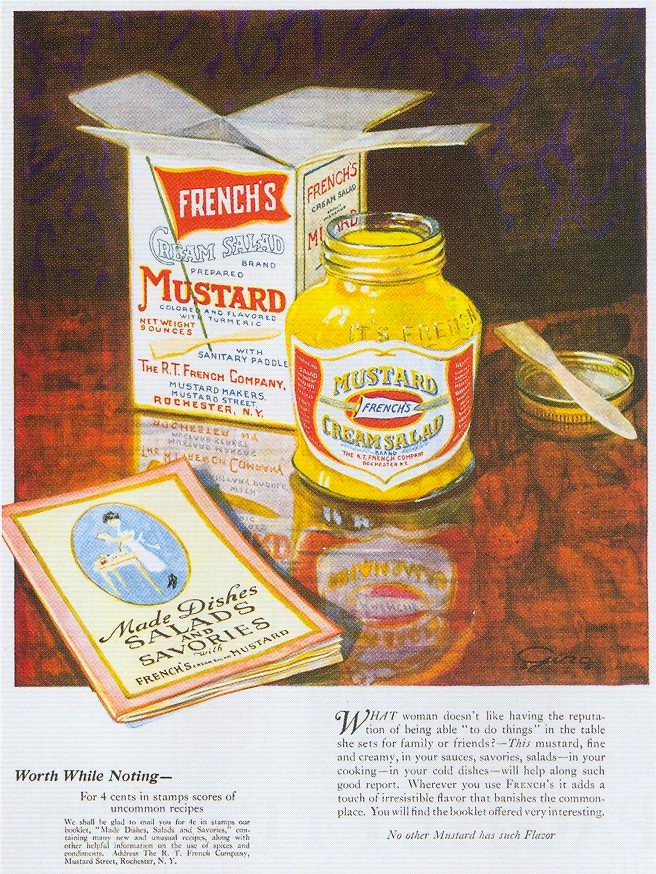
The text says:
"What woman doesn't like having the reputation of being able 'to do things' in the table she sets for family or friends? -- This mustard, fine and creamy, in your sauces, savories, salads -- in your cooking -- in your cold dishes -- will help along such good report. Wherever you use French's it adds a touch of irresistible flavor that banishes the commonplace. You will find the booklet offered very interesting.
No other Mustard has such Flavor"
Is it just me, or is there a whole lotta double entendres happening in that text?)
Anyways, I made mustard. I followed these instructions, and it couldn't have been easier. I even ground the mustard seeds by hand in my new mortar and pestle. I let it sit in the fridge overnight. I tasted it the next day, just by itself, because I was so curious, and it blew my head off with its heat. I did enjoy it -- sparingly -- on a salmon sandwich the other day (with quinoa, gluten-free bread) but it's really a bit hot and I'm not sure how to cool it down other than by applying heat.
So yesterday I bought some fresh steelhead trout and decided to try smearing the mustard on it and baking it in the oven (usually my husband barbecues our fish). I was nervous, as I haven't actually handled fresh fish myself but I'm getting more comfortable with the I-don't-know-how-to-do-this-and-it-feels-really-weird-and-unpleasant feeling and mostly ignored it. I mixed in a bit of maple syrup to tone the mustard down a bit, because I was worried the oven just wouldn't do it enough.
While the fish baked, I got on with the vegetables for my pasta with leeks, greens and pink fish. At the end, I flaked about half my trout into the leeks and greens and saved the other half for whatever we wanted. Mmmm, that fish was delicious. Like Homer, I wish I was eating that fish RIGHT NOW. But it disappeared way too quickly. I will totally do that again.
(I actually took this after I'd eaten most of it, so it doesn't look as good as it tasted. But look at the bowl! Five of them for only $1 each at the Salvation Army and they're from before 1891!)
Tuesday, March 6, 2012
what I'm reading
I'm working my way through a fantastic cluster of books at the moment. I've finished The Dirty Life by Kristin Kimball and A Householder's Guide to the Universe by Harriet Fasenfest. I'm currently reading The Resilient Gardener: Food Production and Self-Reliance in Uncertain Times by Carol Deppe, as well as The Feast Nearby by Robin Mather and The Quarter Acre Farm by Spring Warren.
I'm not too far into the last two because I was so thoroughly pulled into the first three. The Dirty Life reads like a novel, and I devoured it in less than two days, even with two young children constantly trying to tear my attention away from it. Her story is incredible: a Manhattan writer moves to a farm with her new love, a radical farmer. They now run a CSA farm that feeds 200 people everything they need, from meats to veg to sweeteners.
Tonight I went to my monthly critique/photo gathering group. There are four of us involved, and tonight was our second meeting. Even though we have wildly different lives, it seems that we're all grappling with the same struggles, and mostly, photography is the least of them.
This morning I took my son to the library. I wanted to return the first two books I'd already finished, but I'd marked a few pages with passages I wanted to share here first, so I didn't. I came home from my group thinking about the passage I marked in The Dirty Life.
"When we would talk about our future in private, I would ask Mark if he really thought we had a chance. Of course we had a chance, he'd say, and anyway, it didn't matter if this venture failed. In his view, we were already a success, because we were doing something hard and it was something that mattered to us. You don't measure things like that with words like success or failure, he said. Satisfaction comes from trying hard things and then going on to the next hard thing, regardless of the outcome. What mattered was whether or not you were moving in a direction you thought was right."
I love this concept. This is what I'm trying to give myself permission to do.
Though if I'm honest, I'll share Kimball's next sentence: "This sounded extremely fishy to me."
I'm not too far into the last two because I was so thoroughly pulled into the first three. The Dirty Life reads like a novel, and I devoured it in less than two days, even with two young children constantly trying to tear my attention away from it. Her story is incredible: a Manhattan writer moves to a farm with her new love, a radical farmer. They now run a CSA farm that feeds 200 people everything they need, from meats to veg to sweeteners.
Tonight I went to my monthly critique/photo gathering group. There are four of us involved, and tonight was our second meeting. Even though we have wildly different lives, it seems that we're all grappling with the same struggles, and mostly, photography is the least of them.
This morning I took my son to the library. I wanted to return the first two books I'd already finished, but I'd marked a few pages with passages I wanted to share here first, so I didn't. I came home from my group thinking about the passage I marked in The Dirty Life.
"When we would talk about our future in private, I would ask Mark if he really thought we had a chance. Of course we had a chance, he'd say, and anyway, it didn't matter if this venture failed. In his view, we were already a success, because we were doing something hard and it was something that mattered to us. You don't measure things like that with words like success or failure, he said. Satisfaction comes from trying hard things and then going on to the next hard thing, regardless of the outcome. What mattered was whether or not you were moving in a direction you thought was right."
I love this concept. This is what I'm trying to give myself permission to do.
Though if I'm honest, I'll share Kimball's next sentence: "This sounded extremely fishy to me."
Subscribe to:
Posts (Atom)