If you follow me on Instagram or Twitter, you already know that I've developed a bit of an addiction to sewing. After my first and second sewing projects, I made curtains for the kids' room this past August. And a bag made out of old wool blazers.
Then I discovered the Charley Harper fabrics come in a knit. I usually try to get my kids new pyjamas every year for Christmas Eve, but last year I couldn't find any decent ones. I hate putting my kids to sleep in polyester drenched with flame retardant. Anyways, when I saw the Charley Harper knits, I wondered if I could make my kids' pyjamas this year. It was a lot of work, especially because I wanted to surprise them with it, so I had to wait until they were in bed every night. And it was a major learning experience: I really felt like the pants and the curtains were beginner's luck, as this time I had needles break and tension problems and I lost screws and various other challenges. But I did it, with two days to spare.
And they loved them more than I could have imagined. I really didn't think they'd be that excited but they were. When Youngest woke up on Christmas morning, one of the first things he said, as he looked down at his new pyjama shirt, was, "This shirt has a lot of love in it."
I also wanted to make things for my nieces and nephews, but I ran out of time in a serious way. And now Eldest's birthday is just six weeks away and I have a ton of things I want to sew for him. No rest for the wicked I guess.
Showing posts with label making stuff. Show all posts
Showing posts with label making stuff. Show all posts
Monday, December 29, 2014

Thursday, April 17, 2014
I made a bag!
This is from a couple of weeks ago. I just didn't quite finish it.
I'd love to say I've been busy with spring activities to explain the quiet around here. But I haven't. Largely thanks to the total lack of anything resembling spring-like weather. Instead, I've watched five and a half seasons of Gossip Girl. I keep telling myself that once I'm finished the series, life can go back to normal.
I've been getting restless to attempt sewing on my own sewing machine. I bought the old Singer machine two years ago for $40 from a local thrift store. A good friend who knows how to sew tried to help me figure it out back then but it was beyond her. I took it back to the thrift store and they said it worked fine and it was just threaded wrong. And ever since, it has stood on our hearth (preventing my youngest from climbing on the stone ledge and hopefully preventing injury), intimidating the hell out of me. I had lots of ideas for Christmas gifts in both the holiday seasons between then and now. But I just couldn't overcome the intimidation factor.
I invited my friend (the one who helped me make Youngest's new pants -- which he now loves, proclaiming them "not bumpy anymore!") with promises of my buckwheat sourdough pancakes yesterday morning. So she figured out my machine and declared it just fine. And today I made the Adventure Bag from Soulemama's The Rhythm of Family.
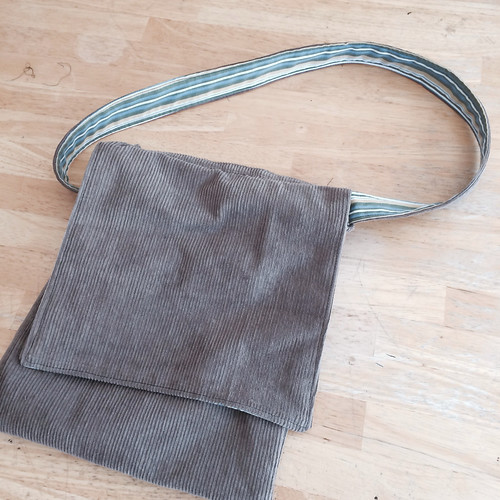
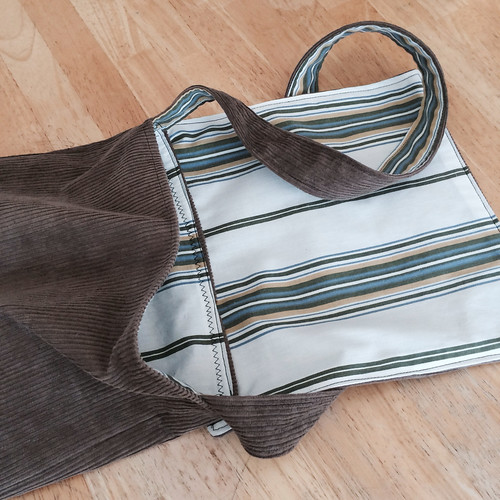
I'm especially proud of myself because I didn't have a pre-made strap, so I figured out how to make a strap. And it worked.
Monday, March 17, 2014
I made pants!
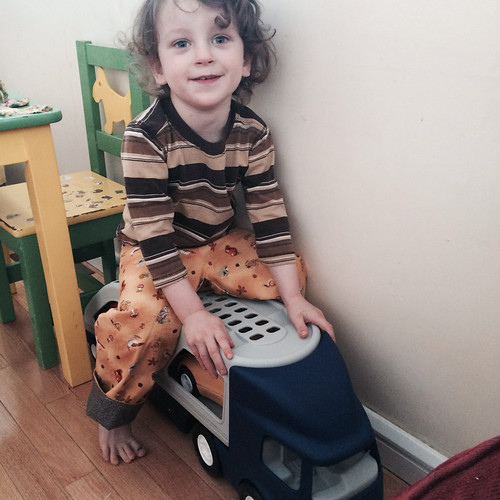
I finished the pants for Youngest this weekend and I really loved the process. Which is a good thing, because he refuses to wear them.
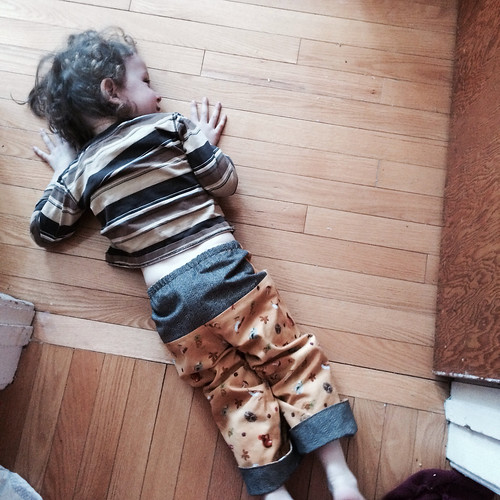
I snuck them on and snapped a few pictures on the go, and when he realized he was wearing them, he immediately took them off.
Oh well. Hopefully this is just the beginning of more sewing projects.
I snuck them on and snapped a few pictures on the go, and when he realized he was wearing them, he immediately took them off.
Oh well. Hopefully this is just the beginning of more sewing projects.
Sunday, February 23, 2014
learning to sew
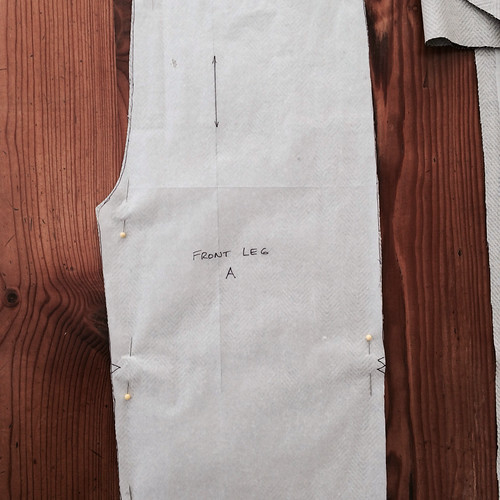
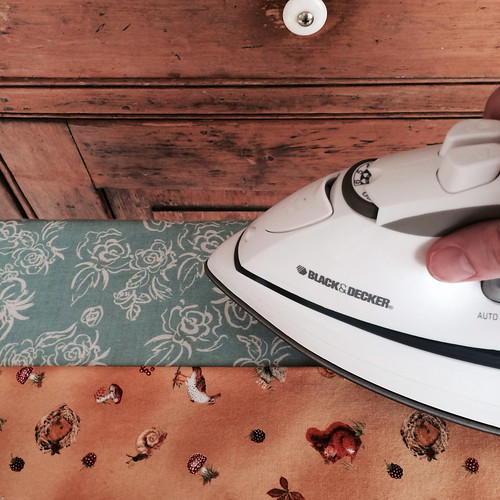
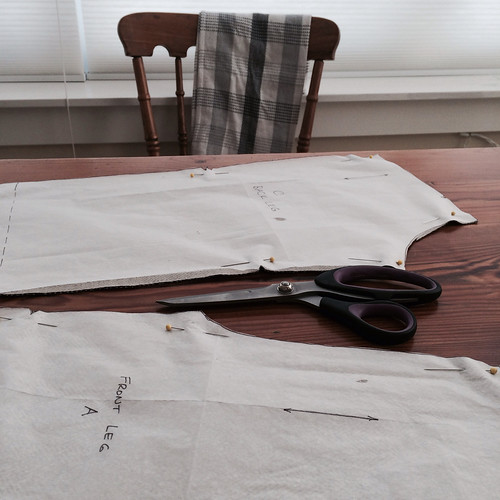
I learned so much yesterday. I went to my friend's house, where she had cleared a table for us to work on in a lovely, sunny room. So we spent a chunk of the afternoon preparing the fabrics for the pair of pants I want to make. I had no idea you could iron paper or that it would be useful when sewing (we lightly ironed the pattern sheet and also the tissue paper we traced the pattern onto). I ironed the fabrics I'm going to use, matched the grain of the fabric (who knew?), pinned the pattern parts to them, and cut the pieces out. So I'm all ready to go next weekend with starting to put the pieces together.
I love that my friend is taking me through the whole process. It's so much easier to learn when you have someone beside you to reassure that yes, it's okay if your hand wobbles a bit tracing the pattern or if the scissors do when you're cutting the fabric. It's so much more efficient than the humming and hawing and fretting I do when I'm learning to do something from a book, all by myself. Plus it's just lovely to visit with a friend in a sunny room, especially when you're still deep in winter.
Monday, February 17, 2014
the ones that got away
I am going to learn how to sew! Like for real!
I have a friend who's going to take me through the whole process of sewing some adorable Quick Change Trousers (pattern by Anna Marie Horner, which I discovered in SouleMama's archive and which are all over the Internet) for Youngest. I'm stoked. I bought fabric last week and I have to say I demonstrated incredible restraint only bringing home the fabric I needed for one pair (well, and a couple of bits called fat quarters of orange prints, which is Youngest's favourite colour).
Here are two fabrics I'm still thinking about that I left at the store (sob!). I really really really wanted to make two pairs of pants but for a variety of reasons I'm having to be especially penny-pinching right now. So I left them. But aren't they so cute?
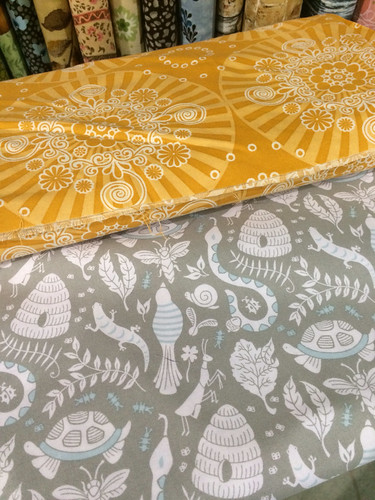
There was another fabric I left behind, which I didn't photograph because I didn't actually have a specific use for it, but it was absolutely lovely and the end of the roll too. Ah well. If I find out that I really like sewing then I'll allow myself to stock up on new fabrics. But not yet.
And these are the fabrics I brought home to make the pants with.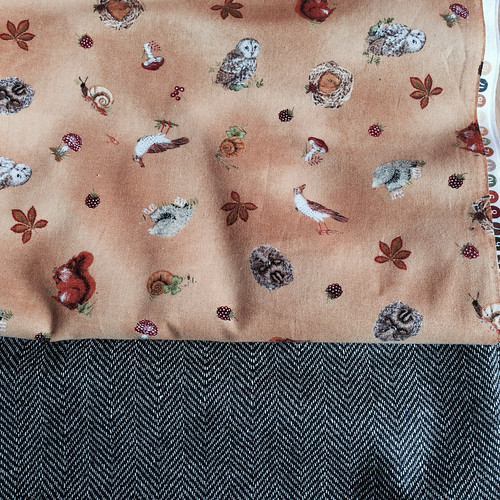
I can't wait!
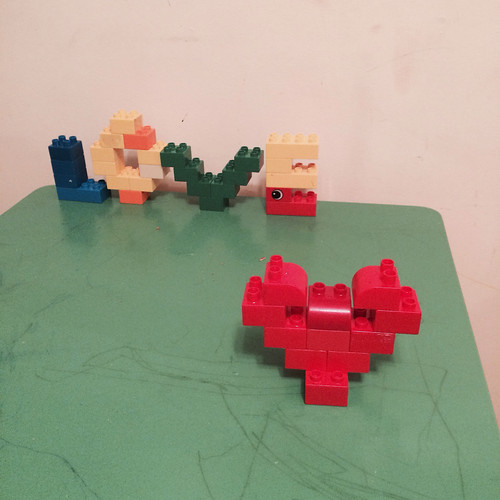
And speaking of frugality, for Valentine's Day I made my kids some Lego hearts, which were out waiting for them when they woke up.
For Eldest:

For Youngest:
I have a friend who's going to take me through the whole process of sewing some adorable Quick Change Trousers (pattern by Anna Marie Horner, which I discovered in SouleMama's archive and which are all over the Internet) for Youngest. I'm stoked. I bought fabric last week and I have to say I demonstrated incredible restraint only bringing home the fabric I needed for one pair (well, and a couple of bits called fat quarters of orange prints, which is Youngest's favourite colour).
Here are two fabrics I'm still thinking about that I left at the store (sob!). I really really really wanted to make two pairs of pants but for a variety of reasons I'm having to be especially penny-pinching right now. So I left them. But aren't they so cute?
There was another fabric I left behind, which I didn't photograph because I didn't actually have a specific use for it, but it was absolutely lovely and the end of the roll too. Ah well. If I find out that I really like sewing then I'll allow myself to stock up on new fabrics. But not yet.
And these are the fabrics I brought home to make the pants with.
I can't wait!
And speaking of frugality, for Valentine's Day I made my kids some Lego hearts, which were out waiting for them when they woke up.
For Eldest:
For Youngest:
Wednesday, January 29, 2014
Tudor Monastery Farm!
Hurrah! Ruth Goodman and Peter Ginn have made another historical farming show: Tudor Monastery Farm. It's just the thing to get us through the rest of January and into February. I just love discovering the ingenuity of how people did things without the so-called mod cons. And Eldest and Youngest both love it too.
I had no idea how many uses they had for urine in the Tudor time and how they smelted lead was fascinating. I also discovered that Tudor gardeners encouraged weeds in their beds, because they ate them too or used them medicinally.
We're only four episodes in, but I can already heartily recommend it. We found it on youtube but some problem with the sound made the background music sound horrendous so we switched to dailymotion.com.
I had no idea how many uses they had for urine in the Tudor time and how they smelted lead was fascinating. I also discovered that Tudor gardeners encouraged weeds in their beds, because they ate them too or used them medicinally.
We're only four episodes in, but I can already heartily recommend it. We found it on youtube but some problem with the sound made the background music sound horrendous so we switched to dailymotion.com.
Monday, January 27, 2014
disappointment

I made another batch of sauerkraut in December. I tasted it around Christmas but it had a bitterness to it that I thought might go away with more time. I was meaning to check it much sooner than now, but my hibernation interfered.
Anyways, I finally tasted it today and the bitterness was worse, if anything. It just doesn't taste yummy, and I'm a big enough sauerkraut fan that I just won't enjoy it. So off to the compost it goes.
I'm not sure exactly what went wrong. But I ended up with less cabbage than I expected and so the salt ratio may have been off. Also, one of the bags I used to weigh it down leaked and although I mixed up a lot of brine to fill the bags for just that eventuality, I also remember thinking I was just paranoid so I might have diluted one. I'm not sure.
Surprisingly, I'm not too bereft. I'll just have to pay attention to the details more next time. I know I'm capable, as I've done it before, so I'll do it again. And who knows? Maybe it was just the cabbage.
Saturday, November 9, 2013
coop tour
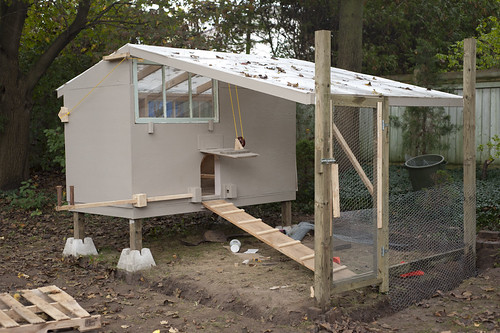
When we decided to build a chicken coop, we had to figure out a plan pretty quickly, with no previous knowledge of what chickens actually need. So we did a lot of research, fast. There's so much conflicting information out there, ultimately every decision came down to gut feel, personal preference or some other subjective method. For the person who comes looking for chicken coop design ideas, here is what we did.
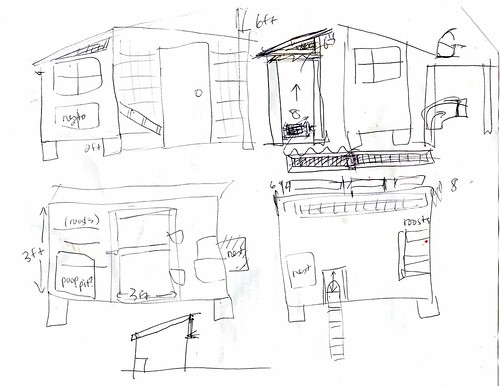
So this is where we started. We chose the dimensions for simplicity, based on plywood sheets of 4 feet by 8 feet. We adjusted the design a bit. The low wall is four feet and the higher wall of the coop is 5 feet tall.
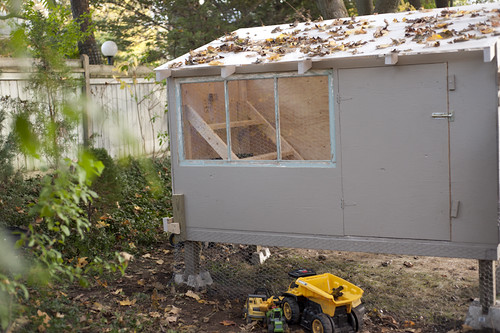
And here it is the day after Halloween. (How happy are we to have our jack o'lantern get eaten? SO happy!)
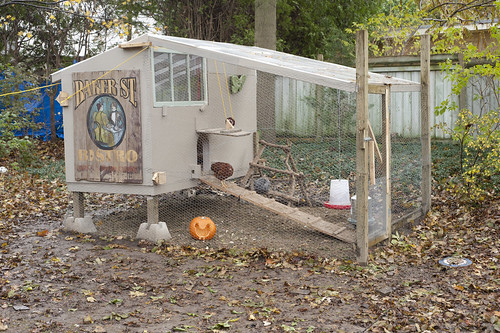
We would have liked to build nest boxes out from the main part of the building, but my dad was only here for two days, so it just seemed more complicated than it was worth. Plus we could always upgrade in the future. For now, the nest boxes are in the main part, just behind the bottom of the Baker St. sign, and we access them through the human door on the east wall.
This picture shows you our roost ladder. Mostly the ladies all crowd onto the top bar, but I think they still have a fair amount of growing to do, so eventually I imagine they won't be able to fit. I read that the roosts should allow 12 inches for each bird's width and we spaced the boards about 14 inches apart from each other I think, to prevent higher birds from pooping on lower birds.
We changed the placement of the windows. Originally I was planning for just one, but we decided to do the two we had in the shed, with one of the east side for morning light, and one that opens on the west side for summer breezes. (The prevailing winds come from the northwest. I was hoping the house would shelter the coop heavy winds, but it does not.)
We were very concerned about ventilation, as we read somewhere that you need one square foot of ventilation per hen, even in winter. We ended up not putting in a vent on the north side like in the drawing because we figured it would be too windy. So we left the spaces between the rafters open, and created a vent on the south wall. Since then we have filled the rafter spaces with styrofoam sheets of insulation, which we'll take out in the summer. We've also covered the vent, which is right over their roosts.
You can see the big vent here: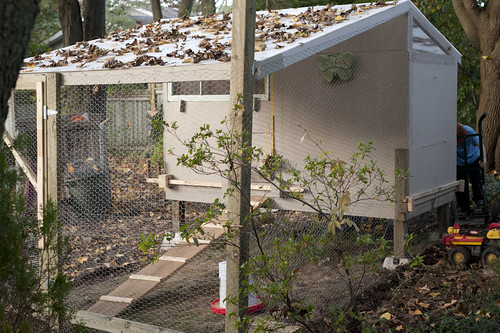
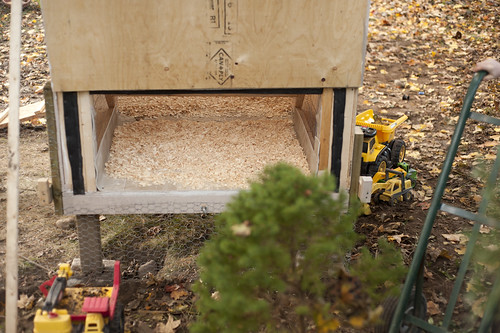
You can also see the other thing on the right-hand wall that I'm very proud of: the poop pit door. It wasn't my idea, but all the best artists are the best thieves. Apparently chickens poop most of their poop at night, when they're roosting. We chicken wired under the roost ladder so the birds can't walk around in their poop, and we made a sort of trap door, so we can just open the door and scrape out the poop. We can do it daily if we want. And the rest of the coop stays pretty clean, since they're mostly outside or sleeping.
Here it is open, with some shavings spread to absorb some of the moisture and odour:
And here are the nest boxes with the first curtains I've ever 'made':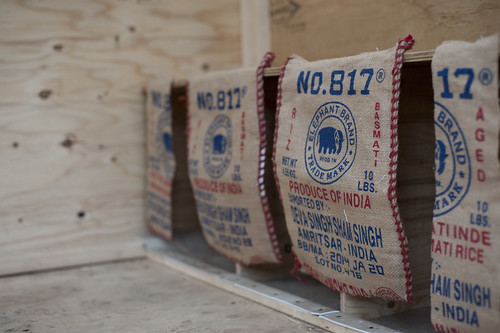
We read somewhere that hens like their nest boxes dark and private, so I thought the curtains would help. I've been holding onto our old rice bags for ages, because they're so beautiful, but I haven't known what to do with them. This seemed a perfect use. We nailed a small board along the floor so that the eggs won't roll out.
The downside of the poop pit is that it significantly reduces the square footage available for the hens to hang out in during the day if they want. I had read to give hens 4 square feet of floor space each, and at 4 feet by 8 feet, ours was big enough for 8 hens. And I pretty much cut that in half with the poop pit. Given that our run is roofed, I'm not too worried as they really don't spend a lot of time in the coop (so far, anyways), but I'm very aware that we're really at max. capacity with our 9 hens. So we will be making some hard decisions for at least some of them when they stop laying eggs.
The last thing to show you is my husband's ingenious mechanism for opening and closing and locking the chicken's pop door. I will confess that at the time I thought he was overcomplicating things, but I let him go ahead because he was so clearly enjoying it. But I have to say, now, I'm pretty impressed.
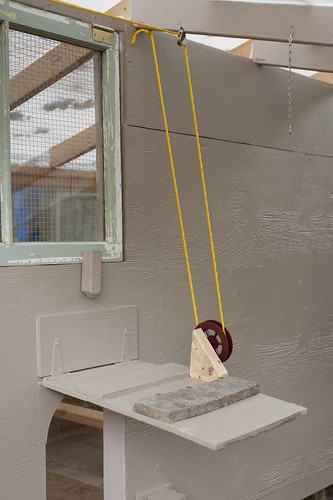
We can open and close it without going into the run, which is nice because we usually do it in semi-darkness at either end of the day. Our run is predator-proof enough that we could just leave it open but I figure when it's cold it's nice to shut them cosy and even safer. Plus we have recently seen raccoon footprints around a few spots where they've tried digging under the fence. (Thank goodness my husband didn't listen to me when I suggested we take the 'easy' way out and just fence down to the ground to avoid all the digging required to bury the fence!)
Back to the door. So my husband rigged up a pulley system that takes the cord up to the roof and outside the run.
He rigged up a neat little thingie to hold the door open.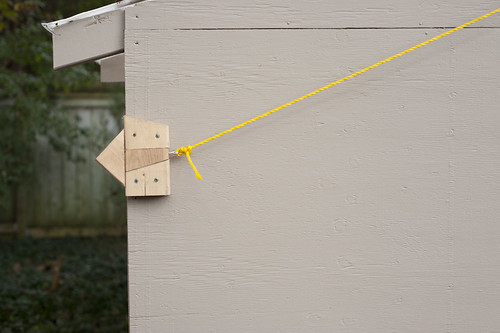
Here the little arrow/handle hanging when the door is closed.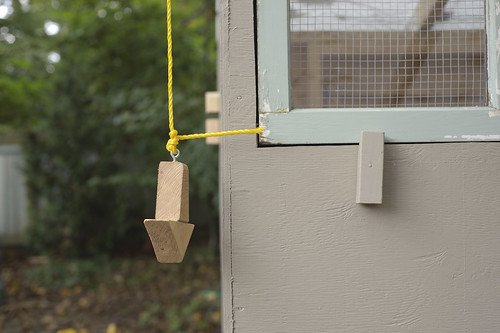
He had to add a weight to the door so it would close most of the way on its own.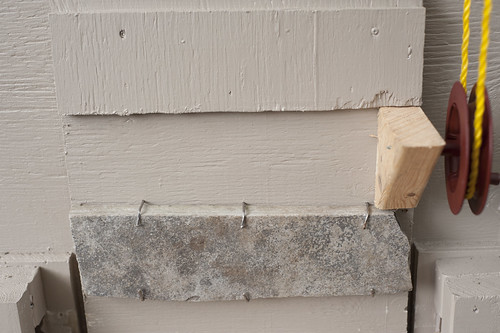
He also built the bits to hold the rod in place, and he made the end of the rod angled on one side so it would go over the door while closing it the rest of the way tight.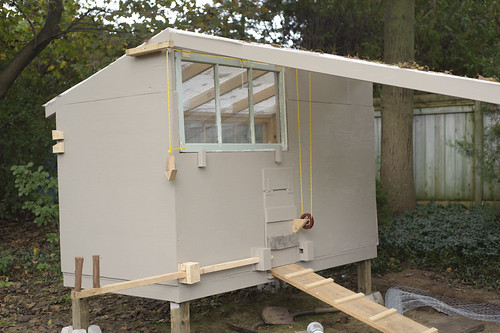
He even made his own handles for the rod from some pruned branches.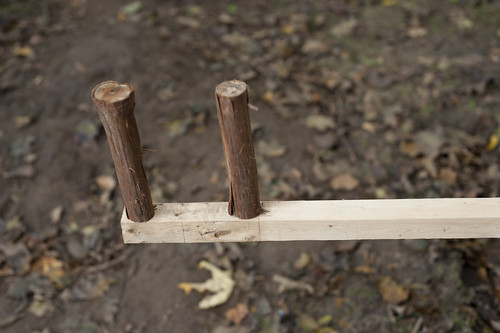
So I think that's just about it. We've also done tons of research and a few amendments for helping the hens manage the cold, but I'll save that for another post.
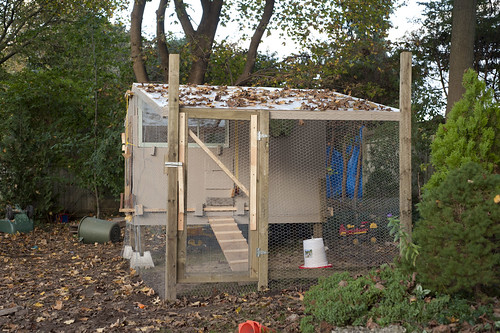
So this is where we started. We chose the dimensions for simplicity, based on plywood sheets of 4 feet by 8 feet. We adjusted the design a bit. The low wall is four feet and the higher wall of the coop is 5 feet tall.
And here it is the day after Halloween. (How happy are we to have our jack o'lantern get eaten? SO happy!)
We would have liked to build nest boxes out from the main part of the building, but my dad was only here for two days, so it just seemed more complicated than it was worth. Plus we could always upgrade in the future. For now, the nest boxes are in the main part, just behind the bottom of the Baker St. sign, and we access them through the human door on the east wall.
This picture shows you our roost ladder. Mostly the ladies all crowd onto the top bar, but I think they still have a fair amount of growing to do, so eventually I imagine they won't be able to fit. I read that the roosts should allow 12 inches for each bird's width and we spaced the boards about 14 inches apart from each other I think, to prevent higher birds from pooping on lower birds.
We changed the placement of the windows. Originally I was planning for just one, but we decided to do the two we had in the shed, with one of the east side for morning light, and one that opens on the west side for summer breezes. (The prevailing winds come from the northwest. I was hoping the house would shelter the coop heavy winds, but it does not.)
We were very concerned about ventilation, as we read somewhere that you need one square foot of ventilation per hen, even in winter. We ended up not putting in a vent on the north side like in the drawing because we figured it would be too windy. So we left the spaces between the rafters open, and created a vent on the south wall. Since then we have filled the rafter spaces with styrofoam sheets of insulation, which we'll take out in the summer. We've also covered the vent, which is right over their roosts.
You can see the big vent here:
You can also see the other thing on the right-hand wall that I'm very proud of: the poop pit door. It wasn't my idea, but all the best artists are the best thieves. Apparently chickens poop most of their poop at night, when they're roosting. We chicken wired under the roost ladder so the birds can't walk around in their poop, and we made a sort of trap door, so we can just open the door and scrape out the poop. We can do it daily if we want. And the rest of the coop stays pretty clean, since they're mostly outside or sleeping.
Here it is open, with some shavings spread to absorb some of the moisture and odour:
And here are the nest boxes with the first curtains I've ever 'made':
We read somewhere that hens like their nest boxes dark and private, so I thought the curtains would help. I've been holding onto our old rice bags for ages, because they're so beautiful, but I haven't known what to do with them. This seemed a perfect use. We nailed a small board along the floor so that the eggs won't roll out.
The downside of the poop pit is that it significantly reduces the square footage available for the hens to hang out in during the day if they want. I had read to give hens 4 square feet of floor space each, and at 4 feet by 8 feet, ours was big enough for 8 hens. And I pretty much cut that in half with the poop pit. Given that our run is roofed, I'm not too worried as they really don't spend a lot of time in the coop (so far, anyways), but I'm very aware that we're really at max. capacity with our 9 hens. So we will be making some hard decisions for at least some of them when they stop laying eggs.
The last thing to show you is my husband's ingenious mechanism for opening and closing and locking the chicken's pop door. I will confess that at the time I thought he was overcomplicating things, but I let him go ahead because he was so clearly enjoying it. But I have to say, now, I'm pretty impressed.
We can open and close it without going into the run, which is nice because we usually do it in semi-darkness at either end of the day. Our run is predator-proof enough that we could just leave it open but I figure when it's cold it's nice to shut them cosy and even safer. Plus we have recently seen raccoon footprints around a few spots where they've tried digging under the fence. (Thank goodness my husband didn't listen to me when I suggested we take the 'easy' way out and just fence down to the ground to avoid all the digging required to bury the fence!)
Back to the door. So my husband rigged up a pulley system that takes the cord up to the roof and outside the run.
He rigged up a neat little thingie to hold the door open.
Here the little arrow/handle hanging when the door is closed.
He had to add a weight to the door so it would close most of the way on its own.
He also built the bits to hold the rod in place, and he made the end of the rod angled on one side so it would go over the door while closing it the rest of the way tight.
He even made his own handles for the rod from some pruned branches.
So I think that's just about it. We've also done tons of research and a few amendments for helping the hens manage the cold, but I'll save that for another post.
Monday, October 14, 2013
Thanksgiving goings-on
Canadian Thanksgiving is coming to a close. We spent a couple of days at my parents' farm, where we had a most delicious turkey dinner, mostly made by me.
It was a spur-of-the-moment decision that I bring a local, pastured turkey instead of my mom buying the usual Butterball. And then, of course, I had to learn how to cook it, because pastured birds are a breed apart for cooking, apparently. And then I had to manage the timing of everything. My mom made a few things and my husband made one, but the rest was mostly me.
I brined the turkey at sunrise. My parents' covered porch is a beautiful thing.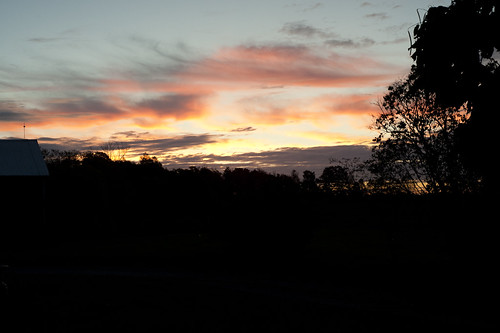
Mostly I was worried that it wasn't anywhere near thawed, and I figured the brining would help a lot with that. I added sage and garlic and peppercorns to the brine and it smelled delicious right away.
Then it only took a little over two hours to cook the 15-pound monster. Apparently pastured turkey cooks much faster than stuffed, all grain-fed birds. My husband told me privately that he thinks it might have been the best turkey he's ever had. It was so moist! It wasn't perfect -- the legs weren't quite done when the breast was, so we carved off the breast and put the rest back in, where it got dried out. But it will be fine in soup.
Before we went to my parents' we went to the garden plot to pull a celeriac for coleslaw and to see how everything was doing. And we discovered the most wonderful wee surprise: that stalwart Delicata squash plant that somehow managed to grow three tiny squash after being nearly destroyed by squash bugs had actually managed to grow FOUR squash. One was hiding under the zucchini plant.

I've got it curing in the kitchen window now.
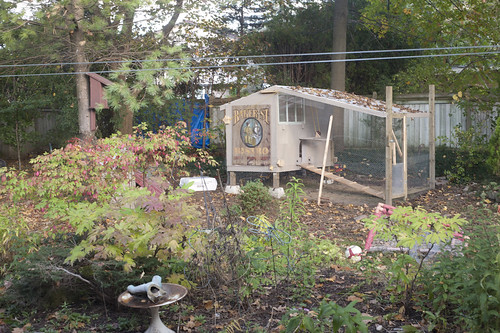
Before we left and after we came home, we put the finishing touches on the chicken coop and the birds arrived tonight. I plan to write a whole post about the coop and the decisions we made, but in the meantime, here is the view from my living room window:
It was a spur-of-the-moment decision that I bring a local, pastured turkey instead of my mom buying the usual Butterball. And then, of course, I had to learn how to cook it, because pastured birds are a breed apart for cooking, apparently. And then I had to manage the timing of everything. My mom made a few things and my husband made one, but the rest was mostly me.
I brined the turkey at sunrise. My parents' covered porch is a beautiful thing.
Mostly I was worried that it wasn't anywhere near thawed, and I figured the brining would help a lot with that. I added sage and garlic and peppercorns to the brine and it smelled delicious right away.
Then it only took a little over two hours to cook the 15-pound monster. Apparently pastured turkey cooks much faster than stuffed, all grain-fed birds. My husband told me privately that he thinks it might have been the best turkey he's ever had. It was so moist! It wasn't perfect -- the legs weren't quite done when the breast was, so we carved off the breast and put the rest back in, where it got dried out. But it will be fine in soup.
Before we went to my parents' we went to the garden plot to pull a celeriac for coleslaw and to see how everything was doing. And we discovered the most wonderful wee surprise: that stalwart Delicata squash plant that somehow managed to grow three tiny squash after being nearly destroyed by squash bugs had actually managed to grow FOUR squash. One was hiding under the zucchini plant.
I've got it curing in the kitchen window now.
Before we left and after we came home, we put the finishing touches on the chicken coop and the birds arrived tonight. I plan to write a whole post about the coop and the decisions we made, but in the meantime, here is the view from my living room window:
Sunday, October 6, 2013
on discipline
I think there's a common assumption, around school and other things in life, that sometimes you just have to do things you don't want to. The implication vis a vis children and especially education is that kids need to learn to do things they don't want to do by being forced to do things they don't want to do.
I confess I've been prone to this anxiety from time to time, especially since we started homeschooling. But I don't think the belief is factual at all. Discipline comes from love. It comes from connecting with the larger goal or need more than the short-term inconvenience or unpleasantness. I learned discipline from loving horses. Getting up early to feed them and turn them out before school, returning home early to muck their stalls, feed them and bring them in... well it wasn't always fun when I was a teenager. But I connected with the larger goal of wanting to ride one horse and compete and improve with one horse, and that required shovelling shit and getting up early and sometimes opting out of fun things to take care of this dependent creature.
I never make my bed. I'm sure some would label that behaviour a lack of discipline. But I think it's a matter of the pleasure of getting into a made bed at night (and I do find this a pleasure on days when I wash the sheets) is not enough to make me take the extra time in the morning or any other time of day. A few nights ago, at midnight, I proclaimed myself a rock star. Not because I was doing anything remotely musical but because I did the dishes when I really didn't feel like it. My husband asked, "Do you ever FEEL like doing the dishes?" And I do. In fact, most of the times I do the dishes because I feel like doing them. Not because I take pleasure in the act, but because I connect to the larger goal of having visual space to breathe (and actual space to prepare food) on the kitchen counters.
André Stern, a grown unschooler and French musician, takes it one step further. He says: "Learning takes place because of the interest we have for things; self-discipline arises from the pleasure one has from doing these things. We believe, wrongly, that discipline is a framework imposed from the outside, that it requires a system that forces the child to do something, to practice. However, the natural discipline comes from the child, from within. It grows out of pleasure and curiosity."
Speaking of discipline, we are still plugging away on the chicken coop. It's feeling pretty heavy and slow, but my dad came today and gave us a bit of a kick start to finish. We aren't finished yet, but the gate to the run is built (thanks, Dad!) and the fencing has begun. Soon, I will get a feeder and waterer, and set up a place to store bedding and feed... Soon, I think we may actually have hens cooing around in our backyard. Soon, when we want an egg, we may just be able to walk to the backyard.
I never make my bed. I'm sure some would label that behaviour a lack of discipline. But I think it's a matter of the pleasure of getting into a made bed at night (and I do find this a pleasure on days when I wash the sheets) is not enough to make me take the extra time in the morning or any other time of day. A few nights ago, at midnight, I proclaimed myself a rock star. Not because I was doing anything remotely musical but because I did the dishes when I really didn't feel like it. My husband asked, "Do you ever FEEL like doing the dishes?" And I do. In fact, most of the times I do the dishes because I feel like doing them. Not because I take pleasure in the act, but because I connect to the larger goal of having visual space to breathe (and actual space to prepare food) on the kitchen counters.
André Stern, a grown unschooler and French musician, takes it one step further. He says: "Learning takes place because of the interest we have for things; self-discipline arises from the pleasure one has from doing these things. We believe, wrongly, that discipline is a framework imposed from the outside, that it requires a system that forces the child to do something, to practice. However, the natural discipline comes from the child, from within. It grows out of pleasure and curiosity."
Speaking of discipline, we are still plugging away on the chicken coop. It's feeling pretty heavy and slow, but my dad came today and gave us a bit of a kick start to finish. We aren't finished yet, but the gate to the run is built (thanks, Dad!) and the fencing has begun. Soon, I will get a feeder and waterer, and set up a place to store bedding and feed... Soon, I think we may actually have hens cooing around in our backyard. Soon, when we want an egg, we may just be able to walk to the backyard.
Friday, September 20, 2013
exhaustion
I spoke too soon. Ever since we started building the chicken coop, which is still unfinished although we've been making steady progress, life has felt awfully overwhelming. I'm not sure the coop is to blame. Work has blown up, in a way that I can't even blog about. I started teaching a 12-week photography class last weekend, and I took on a small freelance gig, in the hopes that it could be the start of a different sort of paid work.
The problem with trying to create change in your life is that it orients you to the future, which can make the present more difficult and harder to enjoy. But I'm working on it.
In the meantime, the coop is coming along. I now know to budget at least double the money and triple the time you think something will take if you're doing something for the first time. Also, maybe start in the spring if it's an outdoor project. Because if you have to paint, you need the nights to stay above 10C.
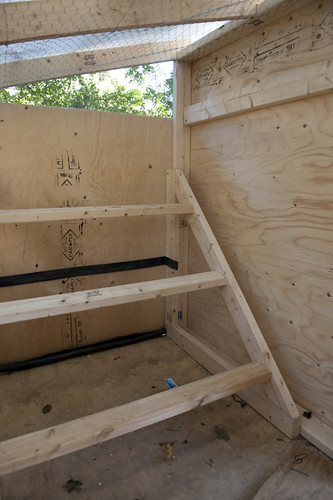
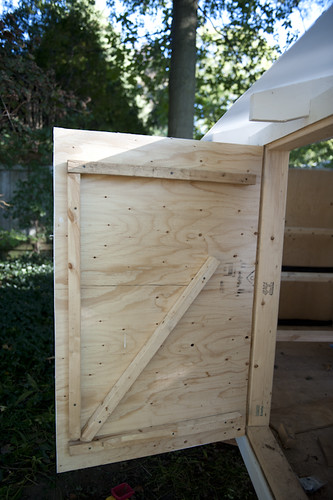
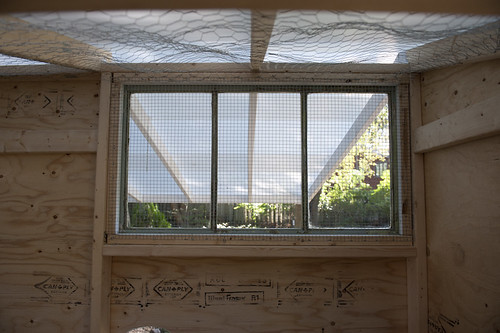
The work on the coop has become considerably less satisfying than the initial burst when, within hours, we went from nothing to a floor and four walls and rafters. Now we have to figure out details and solve problems we didn't anticipate. It took my husband ages to cover the ventilation areas with chicken wire to prevent predator attacks. We've done a lot of the detail work now. We still have a few areas of the coop to cover in chicken wire and then comes the worst job ever. Fencing in the run by digging the chicken wire down a foot deep into the earth. I am NOT looking forward to that. In the meantime, here are some pictures of our progress so far.
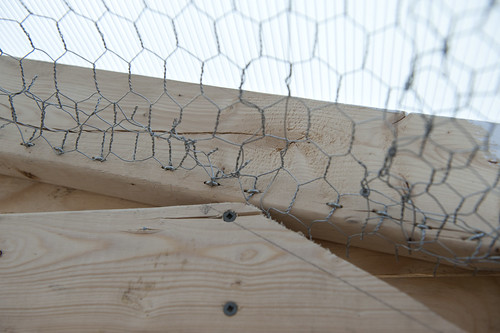
That is a whole lotta staples my husband nailed in. His hands were bloody by the time he was done.
The problem with trying to create change in your life is that it orients you to the future, which can make the present more difficult and harder to enjoy. But I'm working on it.
In the meantime, the coop is coming along. I now know to budget at least double the money and triple the time you think something will take if you're doing something for the first time. Also, maybe start in the spring if it's an outdoor project. Because if you have to paint, you need the nights to stay above 10C.
The work on the coop has become considerably less satisfying than the initial burst when, within hours, we went from nothing to a floor and four walls and rafters. Now we have to figure out details and solve problems we didn't anticipate. It took my husband ages to cover the ventilation areas with chicken wire to prevent predator attacks. We've done a lot of the detail work now. We still have a few areas of the coop to cover in chicken wire and then comes the worst job ever. Fencing in the run by digging the chicken wire down a foot deep into the earth. I am NOT looking forward to that. In the meantime, here are some pictures of our progress so far.
That is a whole lotta staples my husband nailed in. His hands were bloody by the time he was done.
Sunday, September 1, 2013
a chicken coop!
It's funny how a decision can be both relatively spur of the moment and a long, long time coming. I've been pitching the idea of our own backyard hens to my husband for many months now. For many months, he has resisted, citing the work required and the smell. When he came on board the farm fantasy train, though, I wanted to start moving forward. We are growing vegetables in a community garden and we're learning, but there are two very limiting factors to really getting into it: the space available is limited there (although VERY generous by community garden standards) and it's not at home, which makes it difficult to spend as much time and attention there as I'd like to. The next obvious step would be to start growing food at home, and while our yard is very big, it is shady all over and, also, already landscaped. The previous owners were huge gardeners. It's possible I could find a few spots for some leafy greens, but that's probably it, and that's not enough to motivate me.
What we can do in our yard is have chickens and see how we like that. It would probably be a good idea to get some sense of whether we even like caring for them before we do something crazy like buy a farm. So last weekend we decided to just get chickens this fall. I know of a local breeder with heritage breed pullets (I'll tell you all about him after we've supplied ourselves... sorry) that he's willing to sell at the moment, so we needed to move quickly on a coop.
Our first impulse was to buy one ready-made, but I thought back to my 2012 resolution, and we thought about how much Husband and Eldest have been enjoying making neat stuff, and it seemed like a great time to learn something about carpentry and have some fun with creating our own design. It happens that my dad is a whizz at building. He built my family's cottage all by himself, and both his dad and his grandfather were carpenters. And it happened that my parents were unusually available this long weekend to help build it.
So we've spent the last week obsessively learning about what chickens actually need in their dwellings. All week I wasn't sure we'd actually go through with it, but my dad had set a challenge: have all the materials and design done by the time he arrived Saturday morning. We had a concept figured out and bought a bunch of materials but there were still a lot of details to be worked out based on what actually works with the materials, things that we really needed my dad's input on.
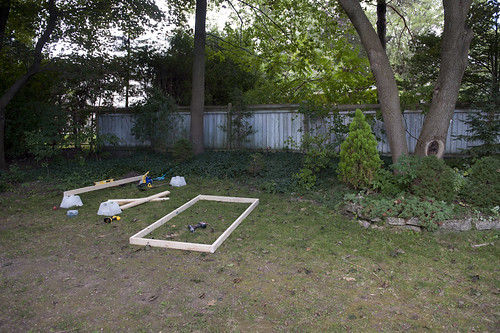
I discovered that I really enjoy building stuff when I can learn from someone who knows what they're doing. Because my dad is a MACHINE, we made such fast progress that I stayed really motivated. Over two days, we were able to go from this:
to this:
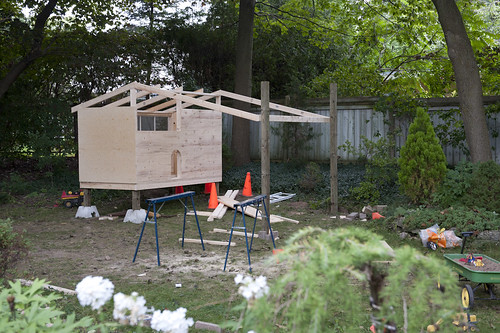
I think my favourite part is that we're using windows we found in our shed. The run will be fenced and roofed as well. I'll go into more detail about our design when it's done.
In the meantime, I will say that I had a great time this weekend. We were all working together on a common goal, and it felt great. Eldest was Grandpa's assistant and loved it. Husband did a lot of childcare and heavy labour while I learned from my dad about how to drill screws in, hammer nails (this wasn't actually the first time he taught me that, but I needed a refresher), and generally asked why every time he quickly figured out an angle or did something apparently without thinking. I used power saws for the first time ever and at the moment I'm feeling reasonably confident about finishing off the rest of the coop. Except for digging the trench to bury the chicken wire al around the perimeter of the coop and run. Our neighbourhood offers such a variety of animals who would love a chicken dinner, I feel like we really need to do our due diligence with predator protection. (Our friend lost most of her flock a year or so ago in a single night to some predator.)
I think working on a joint project is a really good way to connect with my dad. He told me about how he spent a whole summer helping his grandpa build his last house. He was 10 and his grandpa was 80. His grandfather built the whole house, stairs, cabinets, roof and all, using only hand tools and he could figure out everything with the tables on his square whereas my dad had to place each rafter to figure out the bits to cut out. His grandfather's saws were so sharp, he could saw through a 2x4 in three strokes, and every night he went down to his basement to sharpen all the saws he'd used that day. What an amazing experience that summer must have been for my dad.
It was really an amazing and beautiful weekend, working together with three generations. More than once, I thought, "I could get used to this." I even made this zucchini plum chutney, and even though the author said it was better after some time, we tested it today and it was delicious and a gorgeous, well... plum colour. Which is wonderful news because I have a LOT of zucchini to use up. I plan to try it with rhubarb as well.
What we can do in our yard is have chickens and see how we like that. It would probably be a good idea to get some sense of whether we even like caring for them before we do something crazy like buy a farm. So last weekend we decided to just get chickens this fall. I know of a local breeder with heritage breed pullets (I'll tell you all about him after we've supplied ourselves... sorry) that he's willing to sell at the moment, so we needed to move quickly on a coop.
Our first impulse was to buy one ready-made, but I thought back to my 2012 resolution, and we thought about how much Husband and Eldest have been enjoying making neat stuff, and it seemed like a great time to learn something about carpentry and have some fun with creating our own design. It happens that my dad is a whizz at building. He built my family's cottage all by himself, and both his dad and his grandfather were carpenters. And it happened that my parents were unusually available this long weekend to help build it.
So we've spent the last week obsessively learning about what chickens actually need in their dwellings. All week I wasn't sure we'd actually go through with it, but my dad had set a challenge: have all the materials and design done by the time he arrived Saturday morning. We had a concept figured out and bought a bunch of materials but there were still a lot of details to be worked out based on what actually works with the materials, things that we really needed my dad's input on.
I discovered that I really enjoy building stuff when I can learn from someone who knows what they're doing. Because my dad is a MACHINE, we made such fast progress that I stayed really motivated. Over two days, we were able to go from this:
to this:
I think my favourite part is that we're using windows we found in our shed. The run will be fenced and roofed as well. I'll go into more detail about our design when it's done.
In the meantime, I will say that I had a great time this weekend. We were all working together on a common goal, and it felt great. Eldest was Grandpa's assistant and loved it. Husband did a lot of childcare and heavy labour while I learned from my dad about how to drill screws in, hammer nails (this wasn't actually the first time he taught me that, but I needed a refresher), and generally asked why every time he quickly figured out an angle or did something apparently without thinking. I used power saws for the first time ever and at the moment I'm feeling reasonably confident about finishing off the rest of the coop. Except for digging the trench to bury the chicken wire al around the perimeter of the coop and run. Our neighbourhood offers such a variety of animals who would love a chicken dinner, I feel like we really need to do our due diligence with predator protection. (Our friend lost most of her flock a year or so ago in a single night to some predator.)
I think working on a joint project is a really good way to connect with my dad. He told me about how he spent a whole summer helping his grandpa build his last house. He was 10 and his grandpa was 80. His grandfather built the whole house, stairs, cabinets, roof and all, using only hand tools and he could figure out everything with the tables on his square whereas my dad had to place each rafter to figure out the bits to cut out. His grandfather's saws were so sharp, he could saw through a 2x4 in three strokes, and every night he went down to his basement to sharpen all the saws he'd used that day. What an amazing experience that summer must have been for my dad.
It was really an amazing and beautiful weekend, working together with three generations. More than once, I thought, "I could get used to this." I even made this zucchini plum chutney, and even though the author said it was better after some time, we tested it today and it was delicious and a gorgeous, well... plum colour. Which is wonderful news because I have a LOT of zucchini to use up. I plan to try it with rhubarb as well.
Monday, August 26, 2013
apple season
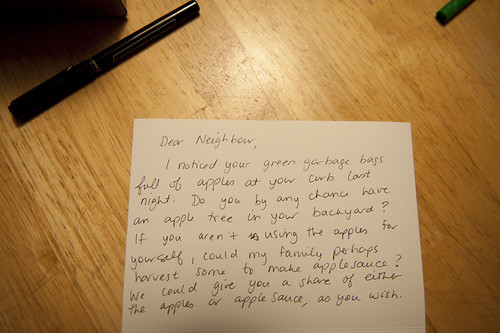
I think this might be a good year for apples. Inspired by Not Far from the Tree, I plan to drop off a few notes like this tomorrow.
Saturday, May 11, 2013
weird things
This morning our pasture-based farmer had fresh chicken feet. I need to get more bone broths into my guy and I think chicken stock has more versatility, flavour-wise than beef. So I picked up a couple bags for 50 cents each. I have a habit of doing things that scare me (not physically -- I have no interest in skydiving or bungee jumping -- but psychologically), and I've been thinking about trying to learning how to butcher a whole animal, just to see if I could. But anyways, the feet. I figured there's no time like the present since it was cold and gray today and due to be colder and grayer tomorrow. I don't know how people keep consuming bone broths through the summer because it adds so much heat and humidity to your house. My goal is to make and freeze as much broth as I can.
So anyways... these creepy chicken feet. They are seriously creepy. If I'd known I might need to peel them and would have to cut their toenails off, I would not have bought them. But I did it, and it really wasn't nearly as bad as I thought. They'd already been peeled, so I didn't blanch them. I just put them in the pot with cold water, a couple tablespoons of apple cider vinegar and let it sit for an hour before slowly bringing it to a simmer. It looked gross for a long time. If I stir it, it still looks gross when they come to the surface of the pot, but it smells quite delicious. It helps that I added some vegetable scraps and onion skins, bay leaves and peppercorns, I'm sure.
So that was weird.
The other weird thing was driving to the other side of town, to a near-deserted milk processing plant to buy an 11-litre jug of organic maple syrup. The deal was totally legit (not like I was buying raw milk or anything), but the producer doesn't sell his syrup at a market. He drives a milk truck part-time, so he just takes orders and delivers them on his way.
I'm not normally picky about organic production for maple syrup since nobody sprays maple trees, but they use slightly different detergents and defoamers than conventional maple syrup production and this bulk quantity was bigger and less expensive than any I've seen elsewhere. This is a very large jug of maple syrup we have now. When we open it, we'll pour some into a smaller bottle and put the big jug in our new (to us) deep freezer until we need to refill the smaller bottle.
Because of our dietary restrictions and also because I've been trying to shop seasonally and locally, we have like four different places we buy our groceries. If I got stuck in a weekly shop frame of mind, I'd pretty much have to shop every day, which I did in the early days of all these changes. I figure one solution is to buy as much in bulk as I can. So some time ago I bought 50 pounds of rolled oats (only to discover that Cure Tooth Decay says oatmeal is about the worst thing for children with tooth decay. Crap.) And now 11 litres of maple syrup. Next up could be a whole lamb or perhaps a side of pork?
* * *
Speaking of weird things, a huge change in our lives is coming soon. My old job was vacant, and with such short severance coverage from my husband's lost job, it just seemed like a no-brainer to see if they might be interested in rehiring me. So as of May 21, my husband will be the primary caregiver and I will win bread and bring home the bacon. This way, I can walk to work in 20 minutes or bike in 5, which means no second car (Hallelujah!) and a bit more family time every day. It means my husband won't have to take the first job that comes his way, even if it were far away. It means we can keep eating well. It means I can apply all the learning I've done about myself over the last year or so to my work life. Of course, it's slightly ironic that it came within months of my finally feeling like I was getting this at-home gig and doing ok at it, and literally within days of feeling like I just had the sweetest life ever. I can still feel that way though. And it will be my new project to feel that way while working.
But oh I will miss my kids. They will be great, I'm sure, and will love the chance to get closer to their dad, but I will miss them. Especially Youngest, who is still nursing on demand. Eldest had weaned by this age, but he was hale and hearty and he was drinking milk. Youngest can't tolerate any nutritious milk substitute, so breastmilk remains very important nutritionally. Especially when he gets sick. He's still pretty thin, so when he loses his appetite, he really suffers.
And of course there are my other interests, which will necessarily take a backseat. Whenever I get worried about this, which is with some frequency, I remind myself that to everything there is a season. We knew my husband worked in a volatile industry when I quit my job, and I accepted that leaving the workforce might mean I couldn't just jump back in whenever I wanted at the same level I was at. I would flip burgers if I needed to. I just didn't expect the situation to arise so soon, before I'd developed the practical skills of resilience I've been working on so slowly. But the fact that I'm literally able to return to where I left is so lucky, I can't help but wonder at the synchronicity, that maybe I still have some stuff to learn there.
Edited to add: I just realized I was missing a pretty important word in the first sentence: FEET. The farmer had chicken feet. I have corrected now.
So anyways... these creepy chicken feet. They are seriously creepy. If I'd known I might need to peel them and would have to cut their toenails off, I would not have bought them. But I did it, and it really wasn't nearly as bad as I thought. They'd already been peeled, so I didn't blanch them. I just put them in the pot with cold water, a couple tablespoons of apple cider vinegar and let it sit for an hour before slowly bringing it to a simmer. It looked gross for a long time. If I stir it, it still looks gross when they come to the surface of the pot, but it smells quite delicious. It helps that I added some vegetable scraps and onion skins, bay leaves and peppercorns, I'm sure.
So that was weird.
The other weird thing was driving to the other side of town, to a near-deserted milk processing plant to buy an 11-litre jug of organic maple syrup. The deal was totally legit (not like I was buying raw milk or anything), but the producer doesn't sell his syrup at a market. He drives a milk truck part-time, so he just takes orders and delivers them on his way.
I'm not normally picky about organic production for maple syrup since nobody sprays maple trees, but they use slightly different detergents and defoamers than conventional maple syrup production and this bulk quantity was bigger and less expensive than any I've seen elsewhere. This is a very large jug of maple syrup we have now. When we open it, we'll pour some into a smaller bottle and put the big jug in our new (to us) deep freezer until we need to refill the smaller bottle.
Because of our dietary restrictions and also because I've been trying to shop seasonally and locally, we have like four different places we buy our groceries. If I got stuck in a weekly shop frame of mind, I'd pretty much have to shop every day, which I did in the early days of all these changes. I figure one solution is to buy as much in bulk as I can. So some time ago I bought 50 pounds of rolled oats (only to discover that Cure Tooth Decay says oatmeal is about the worst thing for children with tooth decay. Crap.) And now 11 litres of maple syrup. Next up could be a whole lamb or perhaps a side of pork?
* * *
Speaking of weird things, a huge change in our lives is coming soon. My old job was vacant, and with such short severance coverage from my husband's lost job, it just seemed like a no-brainer to see if they might be interested in rehiring me. So as of May 21, my husband will be the primary caregiver and I will win bread and bring home the bacon. This way, I can walk to work in 20 minutes or bike in 5, which means no second car (Hallelujah!) and a bit more family time every day. It means my husband won't have to take the first job that comes his way, even if it were far away. It means we can keep eating well. It means I can apply all the learning I've done about myself over the last year or so to my work life. Of course, it's slightly ironic that it came within months of my finally feeling like I was getting this at-home gig and doing ok at it, and literally within days of feeling like I just had the sweetest life ever. I can still feel that way though. And it will be my new project to feel that way while working.
But oh I will miss my kids. They will be great, I'm sure, and will love the chance to get closer to their dad, but I will miss them. Especially Youngest, who is still nursing on demand. Eldest had weaned by this age, but he was hale and hearty and he was drinking milk. Youngest can't tolerate any nutritious milk substitute, so breastmilk remains very important nutritionally. Especially when he gets sick. He's still pretty thin, so when he loses his appetite, he really suffers.
And of course there are my other interests, which will necessarily take a backseat. Whenever I get worried about this, which is with some frequency, I remind myself that to everything there is a season. We knew my husband worked in a volatile industry when I quit my job, and I accepted that leaving the workforce might mean I couldn't just jump back in whenever I wanted at the same level I was at. I would flip burgers if I needed to. I just didn't expect the situation to arise so soon, before I'd developed the practical skills of resilience I've been working on so slowly. But the fact that I'm literally able to return to where I left is so lucky, I can't help but wonder at the synchronicity, that maybe I still have some stuff to learn there.
Edited to add: I just realized I was missing a pretty important word in the first sentence: FEET. The farmer had chicken feet. I have corrected now.
Friday, April 12, 2013
surfacing from sourdough
I am no longer suffocating in sourdough! (AND 19 of my celeriac germinated!) On Easter weekend we went to my parents' place and I put the sourdough starter in the fridge and hoped for the best. It was just fine when I got home, so I left it in the fridge and I'm only feeding it about every three days or so. Which is much less expensive and also gives me more freedom in the kitchen, or elsewhere. Truth be told, I didn't really like any of the gluten-free sourdough breads I made. And I had to make so many sourdough buckwheat pancakes and sourdough muffins to keep up with the starter, that I had no room to eat the sourdough bread. I think I will keep the starter, but maybe I just don't need a lot of bread in my life at the moment. The sourdough pancakes are totally here to stay.
One of the things I like about the sourdough way is that it splits the labour. You spend a few minutes before bed mixing some starter, flour and water for pancakes the next morning, leave it in the oven with the light on overnight and then add fat, eggs, sweetener, salt and some baking soda in the morning before cooking. You mix some starter with oats and flour and just enough water to make dampen it all after breakfast, and then during naptime that afternoon or after dinner, you add other stuff to make muffins. There's a pleasant, slow rhythm about it all. I adapted my favourite banana bread recipe first to be gluten-free then to be sourdough and they're ok. Pretty nice I guess. Moist with a nice texture, although slightly cakier than I would prefer.
Baking has a reputation for requiring absolute precision but I have found that is not true if you loosen your expectations a little. If all you expect is something that is mostly like a muffin and kind of sweet, it's very easy to meet it, and you can take a fair amount of liberty. The last batch of muffins I made I measured the oats, sourdough starter and flour, butter, brown sugar (approximately) and eggs - oh and the baking powder and baking soda (the sourdough probably does add leavening but not enough to fly solo. I just sub the starter for a cup of the flour and half a cup of the water in the recipe). But I didn't measure the pumpkin (probably a cup and a half) or vanilla extract (probably a tablespoon - I made the extract myself last year and it's pretty weak) and I added a whole grated carrot just because. And they came out fine. I did warn a guest that they were a bit odd, but that was more because of the sourdough thing.
I've been exploring the sourdough thing because I'm thinking about only eating soaked or soured grains. My youngest has two extra teeth crowded on top and late last fall we noticed a few dark spots on the most crowded. It must be tooth decay. And one of his teeth is chipped and just today I noticed there is less tooth than yesterday or the day before. Given his nutritionally-deficient past and foods we are avoiding, it just makes sense to me that there is a dietary cause and potential cure. My googling led me quickly to Cure Tooth Decay, but I was skeptical. Then Owlet mentioned it and the diet they adopted. Last week a mother in the homeschool group mentioned that she loved the book and was two months into its most extreme program and she had already noticed a big difference. She lent me the book and I'm nearing the end. I hope to write more about it when I'm done. In the meantime I will say that it's VERY compelling. And as much as I shy away from 'extreme' diets that seek to cut out whole groups of foods, I think I shy away a lot more from dental surgery on my young toddler. One of the things I like about the book and its suggestions is that it is not dogmatic. It encourages you at every turn to do what feels right to you, and the website has testimonials from people who didn't go whole hog but still saw major improvements.
I will say that if we do adopt (more) major changes to our diet (now that we've mostly normalized the last year's changes), I will develop a strategy and add in new foods before removing any. If I had to go back to last spring and do it all over again, I don't know if I would jump on the elimination diet and identifying intolerances. Our dietician suspects that Youngest's intolerances are really secondary, because his gut was so poorly it just couldn't digest gluten, soy and casein - the hardest proteins to digest. We're back on corn now -- I think that was a nonstarter all along, but tomatoes seem slightly iffy. It's also possible that eliminating those foods so suddenly, without getting comfortable with their replacements could have made his deficiencies worse.
Anyways... I don't think I will eliminate grains totally but I may prepare them all better to make them more digestible. And I may try to eliminate refined sugar but I think I very much want to keep honey and maple syrup in my life. But first it's time to add lots more vegetables.
* * *
Here is my favourite banana bread recipe. If you make muffins instead of a loaf reduce the baking time by at least half and possibly more depending on your muffin holder thingie (I don't want to say tin since there are so many other materials).
Banana Oat Loaf
1/2 c butter or marg
3/4 c brown sugar
1 c rolled oats
1/2 c hot water
1 c mashed bananas (3-4, the riper the better, I never measure)
3/4 c chopped nuts(optional)
2 eggs beaten
2 c flour
3 tsp baking powder
1/2 tsp baking soda
1 tsp salt (I usually reduce this a bit)
I add chocolate chips as well (3/4 c-1 c? I just eyeball it)
Place soft butter, sugar, oats, hot water, mashed bananas and nuts in large bowl. Stir until well blended. Add beaten eggs. Beat until well blended. Sift together flour, baking powder, soda and salt; add to first mixture all at once and stir just until dry ingredients are moistened. Fold in chocolate chips.(if desired) Spoon evenly into greased loaf pan. (9 x 5 x 3 inch) Bake at 350 degrees about 65 minutes or until done. Remove from loaf pan, cool on rack. Let stand for a few hours before slicing (If you can wait that long).
I've also used grated zucchini, carrot, often with some applesauce, grated raw beet, grated apple, pumpkin puree and squash puree in place of the bananas.
* * *
I haven't forgotten about my giveaway. I was hoping to have more than one person enter, and that's kind of why I didn't give a deadline. Feel free to enter now if you're interested. Oh -- and the only entrant so far wanted to know what a schmeck is. Schmeck is actually a verb. It means to taste really, really good.
One of the things I like about the sourdough way is that it splits the labour. You spend a few minutes before bed mixing some starter, flour and water for pancakes the next morning, leave it in the oven with the light on overnight and then add fat, eggs, sweetener, salt and some baking soda in the morning before cooking. You mix some starter with oats and flour and just enough water to make dampen it all after breakfast, and then during naptime that afternoon or after dinner, you add other stuff to make muffins. There's a pleasant, slow rhythm about it all. I adapted my favourite banana bread recipe first to be gluten-free then to be sourdough and they're ok. Pretty nice I guess. Moist with a nice texture, although slightly cakier than I would prefer.
Baking has a reputation for requiring absolute precision but I have found that is not true if you loosen your expectations a little. If all you expect is something that is mostly like a muffin and kind of sweet, it's very easy to meet it, and you can take a fair amount of liberty. The last batch of muffins I made I measured the oats, sourdough starter and flour, butter, brown sugar (approximately) and eggs - oh and the baking powder and baking soda (the sourdough probably does add leavening but not enough to fly solo. I just sub the starter for a cup of the flour and half a cup of the water in the recipe). But I didn't measure the pumpkin (probably a cup and a half) or vanilla extract (probably a tablespoon - I made the extract myself last year and it's pretty weak) and I added a whole grated carrot just because. And they came out fine. I did warn a guest that they were a bit odd, but that was more because of the sourdough thing.
I've been exploring the sourdough thing because I'm thinking about only eating soaked or soured grains. My youngest has two extra teeth crowded on top and late last fall we noticed a few dark spots on the most crowded. It must be tooth decay. And one of his teeth is chipped and just today I noticed there is less tooth than yesterday or the day before. Given his nutritionally-deficient past and foods we are avoiding, it just makes sense to me that there is a dietary cause and potential cure. My googling led me quickly to Cure Tooth Decay, but I was skeptical. Then Owlet mentioned it and the diet they adopted. Last week a mother in the homeschool group mentioned that she loved the book and was two months into its most extreme program and she had already noticed a big difference. She lent me the book and I'm nearing the end. I hope to write more about it when I'm done. In the meantime I will say that it's VERY compelling. And as much as I shy away from 'extreme' diets that seek to cut out whole groups of foods, I think I shy away a lot more from dental surgery on my young toddler. One of the things I like about the book and its suggestions is that it is not dogmatic. It encourages you at every turn to do what feels right to you, and the website has testimonials from people who didn't go whole hog but still saw major improvements.
I will say that if we do adopt (more) major changes to our diet (now that we've mostly normalized the last year's changes), I will develop a strategy and add in new foods before removing any. If I had to go back to last spring and do it all over again, I don't know if I would jump on the elimination diet and identifying intolerances. Our dietician suspects that Youngest's intolerances are really secondary, because his gut was so poorly it just couldn't digest gluten, soy and casein - the hardest proteins to digest. We're back on corn now -- I think that was a nonstarter all along, but tomatoes seem slightly iffy. It's also possible that eliminating those foods so suddenly, without getting comfortable with their replacements could have made his deficiencies worse.
Anyways... I don't think I will eliminate grains totally but I may prepare them all better to make them more digestible. And I may try to eliminate refined sugar but I think I very much want to keep honey and maple syrup in my life. But first it's time to add lots more vegetables.
* * *
Here is my favourite banana bread recipe. If you make muffins instead of a loaf reduce the baking time by at least half and possibly more depending on your muffin holder thingie (I don't want to say tin since there are so many other materials).
Banana Oat Loaf
1/2 c butter or marg
3/4 c brown sugar
1 c rolled oats
1/2 c hot water
1 c mashed bananas (3-4, the riper the better, I never measure)
3/4 c chopped nuts(optional)
2 eggs beaten
2 c flour
3 tsp baking powder
1/2 tsp baking soda
1 tsp salt (I usually reduce this a bit)
I add chocolate chips as well (3/4 c-1 c? I just eyeball it)
Place soft butter, sugar, oats, hot water, mashed bananas and nuts in large bowl. Stir until well blended. Add beaten eggs. Beat until well blended. Sift together flour, baking powder, soda and salt; add to first mixture all at once and stir just until dry ingredients are moistened. Fold in chocolate chips.(if desired) Spoon evenly into greased loaf pan. (9 x 5 x 3 inch) Bake at 350 degrees about 65 minutes or until done. Remove from loaf pan, cool on rack. Let stand for a few hours before slicing (If you can wait that long).
I've also used grated zucchini, carrot, often with some applesauce, grated raw beet, grated apple, pumpkin puree and squash puree in place of the bananas.
* * *
I haven't forgotten about my giveaway. I was hoping to have more than one person enter, and that's kind of why I didn't give a deadline. Feel free to enter now if you're interested. Oh -- and the only entrant so far wanted to know what a schmeck is. Schmeck is actually a verb. It means to taste really, really good.
Wednesday, March 13, 2013
what was I thinking?!?
This sourdough is feeling like just another mouth to feed. It's hungry! And not only that, but I have to keep finding ways to use it that people will eat. It's exhausting.
Also, on the day I finally got around to planting celeriac seeds, I calculated how much space they take up verses the size of the plots in the community garden, and decided what I really need is 32 celeriac seeds waiting to germinate. The seeds are tiny and need light and warmth to germinate, apparently, so I just sprinkled them on the surface of the grow mix. But you have to keep these suckers moist, which is difficult when there's no soil on top of them to hold the moisture. I try to mist them with a spray bottle a few times a day, but today I forgot and they totally dried out. I will be so sad if not even one germinates. And it could take anywhere from 10 days to three weeks before that happens, so I have a lot of misting ahead of me.
I thought I was making things that will serve me, but it seems I just created more lives that need my daily care and attention.
Monday, March 11, 2013
more sourdough, two Edna's and a giveaway
It's been more than a week, and my sourdough starter is still alive! On Thursday, it was looking really sad. Almost no bubbles and a whole lot of hooch (alcohol sitting on top, which I have since learned is usually a sign that your starter needs more to eat). So that night, I took some out for sourdough pancakes the next morning, and fed the starter more like a cup and a half of flour instead of the regular cup, and the next morning it was all fluffy and happy again. The sourdough pancakes were not great, but I had suspicions about the recipe so I had another recipe to try next time (Next time was actually this morning, and the second recipe was WAY better. I will definitely make it again.)
I made a different loaf of sourdough bread on Saturday, this one with chickpea flour. It's a bit softer than the first one and not gummy at all, but I don't think the chickpea flavour is doing it for me.
In the meantime, this starter continues to eat and grow and I have to keep finding ways to use it. I *could* just throw some out, but I am stubborn and cheap and that seems a terrible waste. Of course, I don't seem to have a problem with throwing away lousy, gluten-free sourdough bread. Actually, I do. I know I will finish off the chickpea bread toasted and covered in almond butter and jam, and it will be edible.
And the first sourdough loaf I made into gluten-free, dairy-free bread pudding. There's still a teensy bit left in my fridge, if you can get here before I finish it. Bread pudding is one of the top five things I have really missed with our diet restrictions. Maybe even THE top thing. But this bread pudding is even a hit with the gluten-eaters in my house.
* * *
In The Marriage of the Sun and Moon, Dr. Andrew Weil recounts the social context in which coca usage occurs in a South American indigenous culture. They use it if they have to go on a long hike, if they have a lot of work to do, and for celebrations. Weil proposes that a strict social context prevents addiction, and that the problem with drugs in North America is not so much the drugs themselves as it is the lack of social context for their usage.
One of the first vintage of cookbooks I found was The Taste of Country Cooking by Edna Lewis. Although I haven't actually cooked much from it, it's really my favourite. Because it's not just a book of recipes. It's organized by season and occasion. She starts with a menu, writes about the context of the food and meal, and then gives you the recipes. This, to me, seems like how cookbooks should really be done, especially in North America where we've become so divorced not just from seasonality but from the cultural context of eating.
My second-favourite cookbook is probably Food That Really Schmecks for reasons I've already gone into (although, again, I haven't actually cooked a lot from it. The time will come, I am sure). I love that the recipes are all local, and also that my Grandma Ruth owned a copy.
So to make my bread pudding I used Edna Lewis's method but Edna Staebler's ingredients (with substitutions, obviously).
Bread Pudding
1 1/2 cups (almond) milk
1/4 cup melted butter
2 cups diced bread cubes (I didn't measure them, just used all I had)
1 cup sugar
3 eggs, beaten
a handful or two of raisins
1 teaspoon vanilla
sprinkling of cinnamon
I beat the eggs, add in the sugar, mix well. Pour in the milk, stirring as you pour. Add the butter and vanilla. Mix in the bread and let sit. Stir in some raisins if you want. Pour it into a buttered 8x8 baking dish and sprinkle with cinnamon. I let it sit in the fridge overnight before baking it in a roasting pan with some hot water for 40-50 minutes at 300F. I think mine took more like an hour and 20 minutes but I was worried about the pyrex dish breaking so it would have taken a long time for the water to heat up.
Here is what Edna Lewis has to say about bread pudding:
"Bread pudding and other custard dishes were popular in the early spring because of new calves and new green grass producing extra pails of milk, and a good way to use some of the stale bread was to make bread pudding. I can still remember entering the kitchen, which was detached from the main house, and there, cooling on a table near the door, would be a big pan of delicious-looking bread pudding, filling the air with the rich smell of butter and nutmeg rising from the layers of bread that were submerged in a custard of rich milk, fresh country eggs, and plump raisins."
* * *
So I have this problem with thrift stores. I love going to them, at least weekly. One of my problems is a strange sense of loyalty. If I see a plate or a bowl in the same pattern as one I already own, I just can't leave them behind, even if I have no need for more. I feel like I'm reuniting family. And when I saw a copy of Food That Really Schmecks and then More Food That Really Schmecks, well, I had to take them home too. I had an idea to host a giveaway on my blog, because I see those a lot, although they're usually sponsored by the people who sell the thing being given away. So I thought it would be neat to do kind of an anti-giveaway.
I just had one problem: no readers. So I figured I'd wait until I developed a bit of an audience. But someone else had a similar idea, and I just won that awesome book. So now I'm all inspired to just go ahead with the giveaway. Surely someone will drop in by accident and want to play?
Ok. So if you want either Food That Really Schmecks or More Food That Really Schmecks, tell me something about yourself and why you want them. Let me know whether you want one or both. These books are probably best for omnivores, although there are lots of baking recipes and vegetable recipes so maybe I'm just being negative. So who's going to play?
I made a different loaf of sourdough bread on Saturday, this one with chickpea flour. It's a bit softer than the first one and not gummy at all, but I don't think the chickpea flavour is doing it for me.
In the meantime, this starter continues to eat and grow and I have to keep finding ways to use it. I *could* just throw some out, but I am stubborn and cheap and that seems a terrible waste. Of course, I don't seem to have a problem with throwing away lousy, gluten-free sourdough bread. Actually, I do. I know I will finish off the chickpea bread toasted and covered in almond butter and jam, and it will be edible.
And the first sourdough loaf I made into gluten-free, dairy-free bread pudding. There's still a teensy bit left in my fridge, if you can get here before I finish it. Bread pudding is one of the top five things I have really missed with our diet restrictions. Maybe even THE top thing. But this bread pudding is even a hit with the gluten-eaters in my house.
* * *
In The Marriage of the Sun and Moon, Dr. Andrew Weil recounts the social context in which coca usage occurs in a South American indigenous culture. They use it if they have to go on a long hike, if they have a lot of work to do, and for celebrations. Weil proposes that a strict social context prevents addiction, and that the problem with drugs in North America is not so much the drugs themselves as it is the lack of social context for their usage.
One of the first vintage of cookbooks I found was The Taste of Country Cooking by Edna Lewis. Although I haven't actually cooked much from it, it's really my favourite. Because it's not just a book of recipes. It's organized by season and occasion. She starts with a menu, writes about the context of the food and meal, and then gives you the recipes. This, to me, seems like how cookbooks should really be done, especially in North America where we've become so divorced not just from seasonality but from the cultural context of eating.
My second-favourite cookbook is probably Food That Really Schmecks for reasons I've already gone into (although, again, I haven't actually cooked a lot from it. The time will come, I am sure). I love that the recipes are all local, and also that my Grandma Ruth owned a copy.
So to make my bread pudding I used Edna Lewis's method but Edna Staebler's ingredients (with substitutions, obviously).
Bread Pudding
1 1/2 cups (almond) milk
1/4 cup melted butter
2 cups diced bread cubes (I didn't measure them, just used all I had)
1 cup sugar
3 eggs, beaten
a handful or two of raisins
1 teaspoon vanilla
sprinkling of cinnamon
I beat the eggs, add in the sugar, mix well. Pour in the milk, stirring as you pour. Add the butter and vanilla. Mix in the bread and let sit. Stir in some raisins if you want. Pour it into a buttered 8x8 baking dish and sprinkle with cinnamon. I let it sit in the fridge overnight before baking it in a roasting pan with some hot water for 40-50 minutes at 300F. I think mine took more like an hour and 20 minutes but I was worried about the pyrex dish breaking so it would have taken a long time for the water to heat up.
Here is what Edna Lewis has to say about bread pudding:
"Bread pudding and other custard dishes were popular in the early spring because of new calves and new green grass producing extra pails of milk, and a good way to use some of the stale bread was to make bread pudding. I can still remember entering the kitchen, which was detached from the main house, and there, cooling on a table near the door, would be a big pan of delicious-looking bread pudding, filling the air with the rich smell of butter and nutmeg rising from the layers of bread that were submerged in a custard of rich milk, fresh country eggs, and plump raisins."
* * *
So I have this problem with thrift stores. I love going to them, at least weekly. One of my problems is a strange sense of loyalty. If I see a plate or a bowl in the same pattern as one I already own, I just can't leave them behind, even if I have no need for more. I feel like I'm reuniting family. And when I saw a copy of Food That Really Schmecks and then More Food That Really Schmecks, well, I had to take them home too. I had an idea to host a giveaway on my blog, because I see those a lot, although they're usually sponsored by the people who sell the thing being given away. So I thought it would be neat to do kind of an anti-giveaway.
I just had one problem: no readers. So I figured I'd wait until I developed a bit of an audience. But someone else had a similar idea, and I just won that awesome book. So now I'm all inspired to just go ahead with the giveaway. Surely someone will drop in by accident and want to play?
Ok. So if you want either Food That Really Schmecks or More Food That Really Schmecks, tell me something about yourself and why you want them. Let me know whether you want one or both. These books are probably best for omnivores, although there are lots of baking recipes and vegetable recipes so maybe I'm just being negative. So who's going to play?
Wednesday, March 6, 2013
the bread
I got a little overexcited by the poofiness of the sourdough starter yesterday and dove into trying a loaf of bread, using this recipe. I didn't really want a loaf that big or that shape (I mostly eat toast these days) but it was the only gluten-free sourdough recipe I could find that I had all the ingredients for.
I quickly realized I was way more clueless than I thought. For example, was I supposed to use the starter before or after feeding it? The way my day was yesterday meant that the only time I could make the dough with enough time to let it rise before baking was to mix the dough right after I fed it. I suspect i should have given it some time to get happy but not enough to get desperately hungry again before using it. As it was the small amount of starter left in the bowl seemed flat and unhappy all day. The loaf didn't really seem to rise but I baked it anyways because what was the alternative? I had no idea.
The bread is very sour and a little bit gummy when it's not toasted. Maybe I didn't quite bake it enough. There's one part at the bottom of the loaf that doesn't have bubbles but most of it has lots of small holes. Toasted, it has the nicest, chewy, not crumbly texture I've had in a gluten-free bread. To me (and keep in mind I haven't had 'real' bread in a year), it seems like real bread (except for the gumminess).
I was a bit nervous about eating it, because if it didn't bake enough maybe the yeast would still be alive and make me sick. (My brother once told me a harrowing story of drinking wine that still had living yeast in it.) But I had a whole piece of toast this morning and so far no ill effects. I will say it was A LOT more filling than any other toast I've had. I was all set to declare it a failure when it came out of the oven, but maybe it's not. After all, it was quite tasty toasted with almond butter and jam.
I'm realizing that I've never actually had real sourdough bread before. The sourdough I remember was made with white flour and was very fluffy (and delicious), but this is a very dense bread. Or at least the bread that my starter made is very dense. I think maybe I could have waited another day to let the starter build up strength, but who knows?
Apparently starters have individuality. And to care for them optimally, you need to be able to read their signs. I'm feeling like I dove in a bit too recklessly because now I have this starter I have to care for and I don't know how and any move I make could prove fatal. It does seem to have perked up since yesterday but there's been nothing like that big poofiness. There's an ebook I think I will buy tonight and hope it has more info about understanding and nurturing a starter.
Apart from the angst of dealing with the starter, making the bread was SUPER easy. Because there's no gluten to work, I didn't even have to knead the dough. I just mixed it in the mixer, set it to rise, then baked it. Simple. So I'm definitely going to do my best to keep the starter alive and really try to get the hang of this. I love the idea of not having to buy commercial yeast to bake bread, and having to use the starter will serve as good motivation to keep baking.
Monday, March 4, 2013
sourdough
I decided to trying making my own gluten-free sourdough starter yesterday. Given that I haven't actually made any kind of bread before, either gluten-free or otherwise, this was probably pure folly. Actually, I did make yeasted cinnamon buns last year, but I'm not counting that, because it was one-off, and not actually a loaf of bread.) But I'm discovering that I don't like learning things in logical sequences.
Last spring, a seed seller recommended 'easy' plants like radishes to start with and she specifically discouraged me from growing carrots. I grew both but the radishes rotted because we didn't like them. I was pretty sure the promise of free food would keep me motivated, even through challenges, and it did.
Likewise, someone else recommended I start learning to sew with pajama pants and a pattern but that doesn't excite me at all. If I'm going to go to the trouble and discomfort of learning new things, it has to excite me, even if it's something difficult. Even if I fail and I'm disappointed with the results.
So anyways, the sourdough starter. I used this recipe and was prepared to wait 3 to 5 days for bubbles, but this afternoon I lifted the tea towel and there were bubbles! And the stuff had definitely risen. A couple of hours later and there were mini-volcanoes! So I guess tomorrow or the next day, I'll be trying my hand at making gluten-free, sourdough bread.
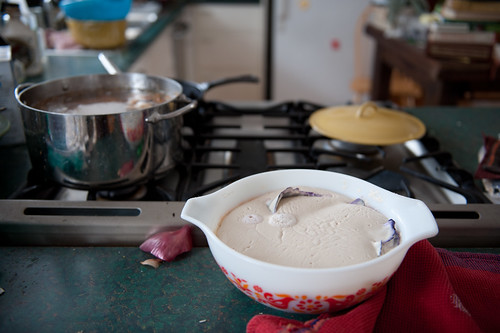
It's ALIVE! (And those are red cabbage leaves sticking out. They provide wild yeast, apparently.)
Last spring, a seed seller recommended 'easy' plants like radishes to start with and she specifically discouraged me from growing carrots. I grew both but the radishes rotted because we didn't like them. I was pretty sure the promise of free food would keep me motivated, even through challenges, and it did.
Likewise, someone else recommended I start learning to sew with pajama pants and a pattern but that doesn't excite me at all. If I'm going to go to the trouble and discomfort of learning new things, it has to excite me, even if it's something difficult. Even if I fail and I'm disappointed with the results.
So anyways, the sourdough starter. I used this recipe and was prepared to wait 3 to 5 days for bubbles, but this afternoon I lifted the tea towel and there were bubbles! And the stuff had definitely risen. A couple of hours later and there were mini-volcanoes! So I guess tomorrow or the next day, I'll be trying my hand at making gluten-free, sourdough bread.
It's ALIVE! (And those are red cabbage leaves sticking out. They provide wild yeast, apparently.)
Tuesday, February 26, 2013
on pickles and sauerkraut
I started reading about wellness and using food for healing more than a decade ago with the books of Dr. Andrew Weil. Lots of what he said made sense to me, although I wasn't a big fan of all his supplement pushing (especially since he sells supplements with his name on them). And one thing really, really didn't sit right with me. He said you should avoid pickles of all kinds. He said they're devoid of nutrients and I think he said they contain a carcinogen.
I am a big pickle fan. A sandwich just isn't a sandwich without sliced pickles in it. When I was pregnant with youngest, all I wanted to eat for the first several months were turkey sandwiches with cheese and pickles. Of course, this made for lots of jokes, and my coworkers even gave me a jar of Vlasic pickles (which I heartily enjoyed). It converted me from my former Bick's loyalty to Vlasic. Although I have a new brand now, Bubbies.
I've always been of the mind that when a body is reasonably well, it knows what it needs. I usually trust my cravings. Sometimes I crave chocolate or chicken and sometimes I crave salad, or Brussels sprouts or coleslaw. If other animals can successfully choose their own food, then surely we can too. (Of course, having a severely malnourished toddler has somewhat disillusioned me. But I still think it's a sound concept.)
So when Dr. Weil said to avoid pickles, he lost me. Don't get me wrong. I still think there's lots of good advice in his books and they're readable as hell, but I likes me some pickles. And I just really felt that they couldn't be so bad as to recommend eliminating them completely. Surely there had to be something good in pickles. Maybe it just hadn't been discovered yet.
Last fall I finally got my hands on a copy of Nourishing Traditions: The Cookbook that Challenges Politically Correct Nutrition and the Diet Dictocrats. While I do think this book is a great reference book and I do plan to buy it, I did struggle with some of what Sally Fallon says in it. I think that if you're going to challenge conventional ideas on any topic by criticizing the studies that led to those ideas, you need to be very precise in your criticisms and really break it down. You can't just say a study was wrong by trotting out two other studies without going into what differed between all the studies. It may be that I was reading too fast and missed important details; maybe her criticism is actually complete. But I didn't see it. The book remains valuable, however, and I have since found the detailed criticisms I needed online.
Back to pickles. Pickles are traditionally just vegetables mixed with salt and fermented. They didn't used to be made with vinegar the way they are most commonly now. The fermentation not only supplies friendly bacteria to your gut, but is also creates enzymes that make many of the vegetable's nutrients more digestible. Apparently Captain Cook brought 60 barrels of sauerkraut on his trip around the world, and his whole crew avoided scurvy for something like 17 months at sea. Aha! I knew there was a reason pickles are good!
Around the time that I was reading Nourishing Traditions, my friend started experimenting with homemade sauerkraut. I couldn't believe the flavour - so delicious and surprisingly complex. And when he offered me half his crock for a big batch of the stuff, I jumped at the chance. I was way too scared to try it myself so it was great to have my friend pick the recipe and do the measuring. I just contributed a few cabbages and got to watch. And I have been happily munching on sauerkraut ever since. I don't have it every day, but I have it often, and I feel good eating it. Maybe this summer I can try fermenting some beets and dill pickles.
I am a big pickle fan. A sandwich just isn't a sandwich without sliced pickles in it. When I was pregnant with youngest, all I wanted to eat for the first several months were turkey sandwiches with cheese and pickles. Of course, this made for lots of jokes, and my coworkers even gave me a jar of Vlasic pickles (which I heartily enjoyed). It converted me from my former Bick's loyalty to Vlasic. Although I have a new brand now, Bubbies.
I've always been of the mind that when a body is reasonably well, it knows what it needs. I usually trust my cravings. Sometimes I crave chocolate or chicken and sometimes I crave salad, or Brussels sprouts or coleslaw. If other animals can successfully choose their own food, then surely we can too. (Of course, having a severely malnourished toddler has somewhat disillusioned me. But I still think it's a sound concept.)
So when Dr. Weil said to avoid pickles, he lost me. Don't get me wrong. I still think there's lots of good advice in his books and they're readable as hell, but I likes me some pickles. And I just really felt that they couldn't be so bad as to recommend eliminating them completely. Surely there had to be something good in pickles. Maybe it just hadn't been discovered yet.
Last fall I finally got my hands on a copy of Nourishing Traditions: The Cookbook that Challenges Politically Correct Nutrition and the Diet Dictocrats. While I do think this book is a great reference book and I do plan to buy it, I did struggle with some of what Sally Fallon says in it. I think that if you're going to challenge conventional ideas on any topic by criticizing the studies that led to those ideas, you need to be very precise in your criticisms and really break it down. You can't just say a study was wrong by trotting out two other studies without going into what differed between all the studies. It may be that I was reading too fast and missed important details; maybe her criticism is actually complete. But I didn't see it. The book remains valuable, however, and I have since found the detailed criticisms I needed online.
Back to pickles. Pickles are traditionally just vegetables mixed with salt and fermented. They didn't used to be made with vinegar the way they are most commonly now. The fermentation not only supplies friendly bacteria to your gut, but is also creates enzymes that make many of the vegetable's nutrients more digestible. Apparently Captain Cook brought 60 barrels of sauerkraut on his trip around the world, and his whole crew avoided scurvy for something like 17 months at sea. Aha! I knew there was a reason pickles are good!
Around the time that I was reading Nourishing Traditions, my friend started experimenting with homemade sauerkraut. I couldn't believe the flavour - so delicious and surprisingly complex. And when he offered me half his crock for a big batch of the stuff, I jumped at the chance. I was way too scared to try it myself so it was great to have my friend pick the recipe and do the measuring. I just contributed a few cabbages and got to watch. And I have been happily munching on sauerkraut ever since. I don't have it every day, but I have it often, and I feel good eating it. Maybe this summer I can try fermenting some beets and dill pickles.
Subscribe to:
Posts (Atom)